Two Dinner Tables
Insight No. 10
“Sometimes the roots of scientific revolutions are found in the most unlikely places.”
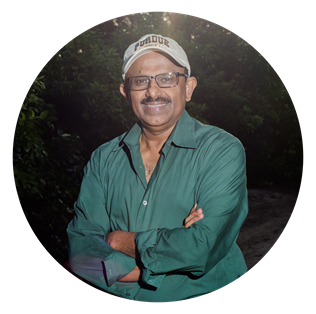
Author: Mani Skaria, Ph.D.
Professor Emeritus, Texas A&M–Kingsville
President & CEO, US Citrus
Production Date: September 9, 2025
When I look back over the decades of my life, two dinner tables stand out more clearly than any others. They were set in very different worlds — one in the elegant residence of the Indian Ambassador in Amman, Jordan, and the other in my own family home in Amayannoor, Kottayam. Though thousands of miles and vast social contexts separated them, they are forever linked in my memory, because together they taught me about dignity, humility, and the meaning of equality.
I was not even twenty-five when I received an invitation I could hardly believe. At the time, my mother was working in Amman, and I had come to Jordan for what I thought would be just a short visit. Back in India, I had recently sat for the prestigious Indian Administrative Service (IAS) exam. The IAS exam is no ordinary test; it selects the young men and women who will go on to serve as key administrators in the nation. In American terms, an IAS officer begins with responsibilities similar to that of a county judge, and within a few years, may hold even higher roles in governance.
The Indian Ambassador to Jordan then was Mr. Abdul Gani Goni, a respected figure from Kashmir and a political appointee of Prime Minister Indira Gandhi. Somehow, he saw in me something worth encouraging. Looking back, I know it was not because of great achievements — I had none at that time. It was simply my youth, my polite nature, my energy, and my general knowledge, which I carried with enthusiasm and sincerity. Those small qualities were enough for him to extend kindness and invite me to his dinner table.
That evening, I found myself seated at a table of only half a dozen people, but the weight of their stature was immense. Among them was Dr. Raja Ramanna, India’s top nuclear scientist, the man who had led the country’s first nuclear explosion during the time of Prime Minister Indira Gandhi. For me, a young man from Kerala, this was more than just a meal — it was my first official dinner, my first time using a fork, knife, and spoon in formal company, and a moment that made me feel I had stepped into history.
The evening left many impressions on me, but one incident shines brighter than all the rest.
An Indian-origin official with the United Nations introduced himself to the table. His words startled me: “I am so-and-so, and my salary is one hundred and fifty thousand U.S. dollars.” At that time, I did not yet know the refined ways of diplomatic introductions, but even in my inexperience, I sensed this was boastful. To measure oneself by dollars felt strange, especially in such a circle.
Then came Dr. Ramanna’s turn. He could have spoken of his pioneering role in India’s nuclear program, of his standing among scientists, or even of his closeness to India’s leadership. Instead, he looked calmly at the group and said: “I am Raja Ramanna. My salary is three thousand rupees.”
That was all. No title. No elaboration. Just his name and a modest salary in rupees — the national currency of India, and a sum that paled against the UN official’s figure in dollars. The silence that followed was powerful. For me, a young man at the table, it was like lightning: true greatness did not require boasting. In that instant, I saw humility as a deeper strength than power or money.
The Ambassador must have seen my eagerness, because he later invited me to other such dinners when important Indian guests visited Jordan. Years later, I would return to Amman as part of a USAID team, sitting again at dinner tables in the same diplomatic circles. By then I had grown older, more seasoned, and more aware of how such gatherings worked. And I can say with certainty: never again did I hear anyone introduce themselves by the weight of their salary. That strange moment in my youth — the clash between a man’s boast in dollars and Dr. Ramanna’s quiet humility in rupees — has remained unmatched in my entire life.
Years later, back in my family home in Amayannoor, I wanted to act on what I had learned. I thought to myself: If I could sit with ambassadors and scientists as an equal, why should I not extend the same honor to those who worked around me at home?
One evening, at our family dinner table, we invited AK, our neighbor and handyman, to eat with us. AK was very fond of me. In fact, in those days, I was something of a “hero” to him, and his respect for me was plain. Out of that respect, I wanted to bring him closer — to offer him the dignity of sitting and eating at the same table.
But he refused. No matter how much I urged, no matter how many times I held his hand and said, “Please, sit with us, eat with us,” he only shook his head. “No, no, no, I cannot.”
It was not because he disliked me. Quite the opposite. It was because of the cultural norms of that time in Kerala. In those years, a handyman or worker would not sit at the same table as the family they served. Out of humility and tradition, they ate from a lower stool or on the floor. That was simply the way things were.
I felt helpless. My heart wanted to lift him up, to make him feel included. But his own sense of respect for boundaries and traditions held him back. He would not accept my invitation, and in that, I saw another form of humility.
—
Reflection
The contrast between these two tables has shaped me for life.
At the Ambassador’s table in Amman, I was the youngest, the least experienced, the one with the smallest résumé. Yet I was seated as an equal, and shown the dignity of recognition. From Dr. Ramanna, I learned that humility is the crown of true greatness. A man whose work had changed the course of India’s destiny did not measure himself in wealth or titles. His few words — “My salary is three thousand rupees” — spoke louder than any claim of status ever could.
At my own table in Amayannoor, I tried to carry that lesson forward. I wanted to give AK the same dignity I had been shown. But I learned something else that night: equality cannot simply be offered; it must also be received. And sometimes, the weight of cultural boundaries is heavier than an individual’s will to cross them. For AK, sitting at my table would not have felt like honor, but like breaking a sacred norm of humility.
Both Dr. Ramanna and AK are no more. But if they were here today, I would tell them both how deeply they influenced me — one through his humility at the pinnacle of achievement, and the other through his humility at the ground level of daily life. Together, they taught me that dignity wears many faces.
Two dinner tables. Two worlds. One lesson: true dignity is never about the currency you announce, but about the way you honor others.
Famous Person Quote:
“I am Raja Ramanna. My salary is three thousand rupees.”
–Dr. Raja Ramanna
Dr. Mani Skaria Quote
“Two dinner tables. Two worlds. One lesson: true dignity is never about the currency you announce, but about the way you honor others.”