An Academic Case Study in Captive Service Pricing: Lessons from an Industrial Fan Installation
Insight No. 13
“Price is what you pay. Value is what you get.”
—Warren Buffet

Author: Mani Skaria, Ph.D.
Professor Emeritus, Texas A&M–Kingsville
President & CEO, US Citrus
Production Date: September 12, 2025
1. Introduction: The Promise of Turnkey Service
Industrial installations are expected to deliver both performance and peace of mind. Yet, when service pricing becomes fragmented, even the smoothest installations can turn into cases of misplaced trust and unclear accountability.
2. Case Background and Purchase Details
This case study examines a recent installation of two large industrial ceiling fans—PowerFoil D, 12-foot diameter, 200–277 volt, 1–3 phase—supplied by a leading industrial fan manufacturer in the country. The total purchase amounted to $22,967, including $16,852 for the fans, $5,540 for installation, and $575 for shipping.
3. Communication and Pre-Installation Planning
From the buyer’s perspective, the quoted price was understood to represent a turnkey installation: a complete setup where the fans would be fully mounted, wired, tested, and ready for operation. To prevent any misunderstanding, the buyer had proactively requested electrical specifications and shared photographs of the nearby electrical junction box with the company’s representatives well before installation began.
4. Site Work and Physical Installation
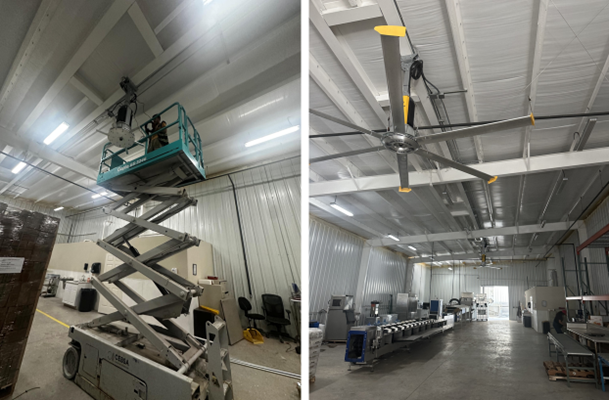
The company assigned a subcontractor referred to as R, who inspected the site and returned a few days later with a two-person crew and a lift. The physical installation was completed efficiently in a single day. The fans were securely mounted and aligned to professional standards.
5. The Missing Connection: Where the Process Stopped
However, when it came time to connect the electrical wiring, R hesitated. He informed the buyer that he was awaiting further instruction from the company, as his task was limited to “installation only.” The electrical connection and system commissioning, it appeared, were not included under the installation charge of $5,540.
6. Policy vs. Capability
A follow-up message soon arrived from D, a colleague of R, clarifying that they could not proceed with the electrical connection without prior authorization from the manufacturer and that doing so might “void the warranty.” Notably, the manufacturer’s team included licensed electricians who could have performed the connection; the barrier was not technical capability but policy/authorization, which left the project incomplete.
7. Captive Service Pricing: An Academic Analysis
This experience highlights a subtle but significant practice in industrial service models—Captive Service Pricing. In this model, the manufacturer retains exclusive control over certain stages of installation or maintenance, effectively ensuring that the customer remains dependent on the company’s approved technicians for any further work, including commissioning or future adjustments.
8. Practical Implications
The practical impact is twofold:
1. The customer experiences a delay in project completion and uncertainty about next steps.
2. The company maintains a form of service dependency, where warranty coverage becomes a tool to enforce continued patronage rather than a sign of support.
9. Technical Excellence vs. Procedural Opacity
The paradox is that the equipment itself—robust, efficient, and well-designed—fulfilled every promise of performance and quality. Yet, the fragmented service delivery undermined the sense of trust and transparency expected from a top-tier manufacturer. In academic terms, the incident demonstrates how technical excellence can be overshadowed by procedural opacity.
10. Lessons Learned
1. Define “Installation” Clearly.
2. Obtain a Written Scope of Work.
3. Verify Warranty Conditions.
4. Understand the Role of Subcontractors.
5. Demand Transparency in Service Pricing.
11. Broader Significance
These lessons are not isolated to this single case—they reflect a wider challenge across industrial sectors where service compartmentalization creates hidden costs and strained relationships.
A Practical Reflection: When Installation Becomes Decoration
During a follow-up discussion, my colleague William asked a simple question:
> “Is the fan working?”
I replied, “No, because there is no electricity.”
He smiled and said, “So it’s a decoration then?”
I laughed and agreed, “Yes, for now it’s a decoration.”
William concluded, “That’s like buying a car without an engine.”
And I added, “Well, you can buy a car without an engine—if it’s a Tesla.”
Humor aside, this brief exchange underscores the absurdity of incomplete installations: equipment that’s technically delivered but not operational. It’s a reminder that true completion lies in functionality, not form.
12. Conclusion: Transparency as a Bearing of Trust
The installation of the two industrial fans serves as more than an operational anecdote—it is a teaching example of how gaps in definition and transparency can distort the meaning of service value. While the fans themselves now stand as symbols of engineering reliability, the process of bringing them to life exposed weaknesses in communication and accountability. In industrial relationships, transparency is not optional. It is the silent bearing that keeps trust rotating smoothly. When companies prioritize clarity over control, they build lasting partnerships instead of temporary transactions.
13. Quote for Reflection
“A warranty should be a shield for the customer, not a sword to force compliance with inflated service costs.” –Dr. Mani Skaria
Appendix A — Market Comparison Snapshot: Online vs. Captive Pricing
**Figure 1.** Installed 12-foot industrial fans at the U.S. Citrus facility in Hargill, Texas, illustrating physical placement and scale within the work area.
Interpretive Analysis
For a typical customer—or even a business us at US Citrus —the term’ fan installation’ implies a complete, functioning setup: once installed, the fan should be powered, connected, and operational. However, in this case, the company divided the process into two separate categories: mechanical installation and electrical connection. While this may be technically correct within the company’s internal language, it conflicts with the common understanding of installation and creates confusion about what was actually covered under the quoted service.
The original quotation from Big Ass Fans listed “installation – $5,540” without any clarification that the cost did not include electrical work. This omission, coupled with the salesperson’s assurances that two qualified technicians would be sent from Kansas because the fans were “specially engineered,” led the buyer to believe that the cost included travel, lodging, and professional labor from company employees—not subcontractors based only 50 miles away.
Before installation, U.S. Citrus had sent a photograph of the existing electrical junction box, showing a readily available connection point within five feet of the fan’s intended mounting location. This was done to avoid any confusion. Yet the salesperson later claimed that he never received the photo and did not have the buyer’s email address, despite prior documented communications. Such statements appeared inconsistent and suggested deliberate avoidance or poor internal coordination, further eroding trust.
Adding to this chain of events, while preparing this case study, the buyer conducted an independent online search for a 12-foot industrial fan—the same size as those purchased. On Amazon, a comparable model from the same brand, Big Ass Fan, appeared with a price tag of $4,199, delivered, which is significantly lower than the per-unit cost billed to our company. This unexpected discovery deepened the perception of disproportionate pricing and raised serious questions about captive pricing practices, where proprietary service requirements and warranty clauses effectively prevent buyers from seeking competitive installation or sourcing options.
Taken together, these experiences reveal a pattern of ambiguous communication, selective omission, and an inflated perception of pricing. What was presented as a premium, engineered service from a specialized company turned out to be a standard installation subcontracted locally, completed in one day without the expected technical expertise or transparency in scope.
From both a business ethics and consumer protection perspective, the case underscores the importance of clear communication, full disclosure, and integrity in commercial transactions. Even if technically defensible, the company’s actions undermined the principle of fairness and left the buyer with a justified sense of misrepresentation.
In conclusion, this case serves as a cautionary lesson on the importance of perception and precision in service quotations. The language of “installation,” when left undefined, can become a tool for confusion rather than clarity—and in this instance, it transformed a routine industrial purchase into an instructive study on pricing transparency, accountability, and trust in business practice.
**Figure 2.** Online listing of a 12-foot industrial fan priced at $4,199 with free delivery (screenshot from Amazon, October 2025).
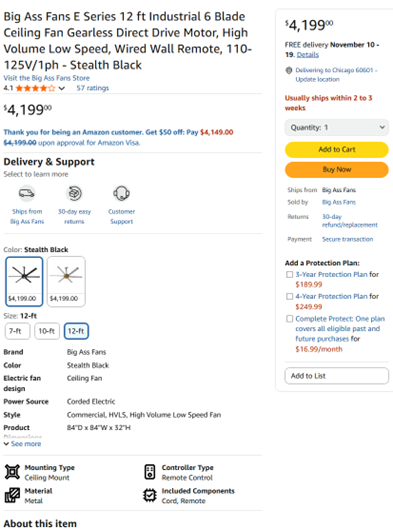
Interpretive Note — The comparison between the manufacturer’s retail price of $4,199 per unit (as publicly listed online) and the total project invoice of $22,967 for two fans (including installation and shipping) reveals the magnitude of cost layering common under captive service pricing models. While professional installation and warranty protection hold value, the differential underscores how tightly controlled service structures, required authorizations, and subcontractor dependencies can double or triple the buyer’s outlay—turning transparency into a decisive factor in preserving both operational trust and economic efficiency.