Bending to Rise: The Hidden Power of Touching Someone’s Feet
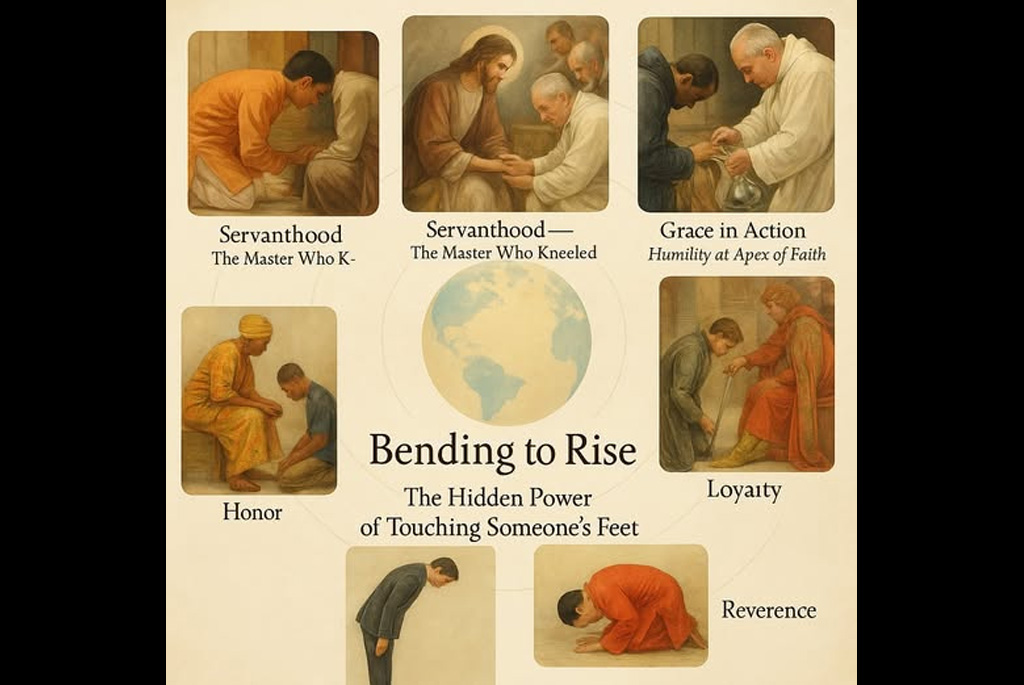
Insight No. 19
Author: Mani Skaria, Ph.D.
Professor Emeritus, Texas A&M–Kingsville
“When the fruit grows on the tree, the branch bends down.” – Indian Proverb
There is great cultural, scientific, and spiritual significance behind the act of touching someone’s feet — a gesture deeply rooted in humility and reverence. It examines parallels across civilizations — from China’s kowtow and Japan’s bow to Africa’s kneeling customs — revealing how diverse societies express respect through physical gestures of humility.
________________________________________
The Gesture That Speaks Without Words
At weddings, temples, and family gatherings across India, a familiar scene unfolds.
A young person bends low to touch the feet of an elder. Sometimes the elder resists, pulling them up with a smile. Other times, the palms touch the ground, the head bows, and the moment completes in silence.
This small act — Charan Sparsh, or “touching the feet” — is not about hierarchy. It is about humility, connection, and continuity. In that single motion, wisdom passes from one generation to the next without a word spoken.
The Meaning and Origin of the Gesture
In ancient Sanskrit texts, the act is called Pranāma, literally bowing with reverence. The elder’s feet, symbolizing the path already traveled, become sacred ground. The gesture dissolves ego and invites blessings — the invisible current of goodwill known as Āshirvāda.
Beyond ritual, it is a universal truth: learning begins when pride ends.
A Personal Reflection: From Discomfort to Clarity
A couple of decades ago, whenever I saw someone touch another’s feet, I must confess, I felt uneasy. I could not imagine myself doing it — especially in public. Perhaps it was ego, or perhaps a quiet discomfort born from an inferiority complex, caught between tradition and modern aspirations.
In those days, dignity was measured by how Western or independent we appeared. To bow before someone seemed old-fashioned. But as years passed, I realized: humility does not diminish us — it enlarges us.
Today, when I look at India — the country where I was born — I see a land transformed. From a struggling post-independence nation, it has become a confident, creative, and rising global force. And from this point of abundance, touching someone’s feet has a renewed beauty.
Because when a nation — or a person — grows beyond insecurity, bowing becomes a mark of grace, not surrender.
“Humility is not the shadow of weakness; it is the sunlight of strength.” – Dr. Mani Skaria
The Breaking of Ego
The ego is the most sophisticated illusion we carry. It builds walls between people, generations, and even nations. Touching someone’s feet is one of humanity’s simplest ways to break that wall.
The body bends, but what truly bends is the self that says “I.”
That brief bow reminds us that we are part of something larger — a lineage of love, learning, and life itself.
When the ego breaks, what enters is light. And if the world learned this art of humility — from homes to parliaments — we would find fewer arguments and more understanding.
The Spiritual Parallel: When the Master Becomes the Servant
Through faiths and centuries, humility has always been the true mark of greatness. In the Gospel of John, Jesus Christ kneels and washes the feet of His disciples — a gesture of astonishing equality. He tells them, “If I, your Lord and Teacher, have washed your feet, you also ought to wash one another’s feet.”
That moment redefined leadership. The divine knelt before the ordinary, proving that service, not power, is the foundation of holiness.
To this day, Popes continue this ritual every Maundy Thursday, washing the feet of prisoners, refugees, and the poor — echoing the same eternal truth: greatness is measured by how low one can bend for another.
Though India’s Charan Sparsh is unique, its spirit echoes across civilizations.
When we bow in humility, the divine within us bows to the divine in another. In that sacred moment, there are no elders or youth, no teacher or student – only souls meeting in reverence.