HOWDY, HATS, BOOTS, and the BRAHMAN COW – a Texas Story that Walks, Talks, and Bridges Worlds
Insight No. 22
Author: Mani Skaria, Ph.D.
Professor Emeritus, Texas A&M–Kingsville
“You can tell a lot about a man by the way he says hello, and by the dust on his boots.” — Will Rogers, American humorist, actor.
When a Texan says “Howdy!”, he isn’t just saying hello. He’s offering a handshake without touching your hand. Add a hat tipped forward and a pair of boots raising a little dust, and you have more than a greeting — you have a whole language of belonging. It’s a dialogue of soil, spirit, and self‑respect – That’s the Lone Star Special!
The Word That Smiles
“Howdy” was born from “How do ye?”, an old English salutation that crossed oceans and saddled up on the American frontier. Some greetings carry distance — “Good morning,” “Hello,” “Greetings.” But “Howdy” closes the gap. It melts formality into friendliness. In Texas, the word is both sound and signal — a quick, gentle code that says, “I come in peace.” At Texas A&M University, “Howdy” is the official campus greeting. Every freshman learns that if you pass a stranger, you say it — not as a rule, but as respect.
Because “Howdy” doesn’t just open a conversation; it opens hearts.
The Hat That Tips and Teaches
A cowboy hat isn’t just an accessory; it’s a portable philosophy. It shields you from the sun, frames your face against the wind, and reminds you to carry yourself tall. When a cowboy meets someone, he lifts his hat slightly — a gesture rooted in chivalry. It’s humility meeting dignity. The hat may cost a hundred dollars or a thousand, but the tip is priceless. Even in a modern boardroom, a Texan might keep one hanging on a hook behind his desk — a silent reminder that under the brim lives a lesson: stay grounded, no matter how high your crown sits.
The Boots That Walk the Talk
Boots were made to work before they were made to impress. The high heel kept the foot in the stirrup, the pointed toe slipped easily in and out, and the leather carried dust, not perfume. Every scratch tells a story — a fence climbed, a horse mounted, a promise kept. Boots are autobiographies: they reveal whether you walked the miles you talk about. Today, they stride from ranch to runway, from fields to festivals — but each pair still whispers the same message: earn your walk before you shine your buckle.
When Howdy, Hats, and Boots Meet Technology
Even in the digital age, Howdy has found new life. Some startups and chatbots now open with “Howdy!” as their default greeting. Technology, too, is learning the Texan art of warmth. A cold interface feels friendlier when it says Howdy instead of Welcome. The same spirit inspires modern brands that fuse Western heritage with inventive design.
It’s proof that tradition and innovation can share the same saddle.
A Personal Howdy: Lessons from Sid Miller’s Hat
One morning in Hargill, Texas, the word Howdy came alive in the most Texan way possible. Texas Commissioner of Agriculture Sid Miller visited our US Citrus company, spending over two and a half hours greeting employees and walking through the facilities, including greenhouses and nursery rows. Before his arrival, my son, Ron, had surprised me with a symbolic Cowboy hat to welcome our commissioner. A five‑and‑a‑half‑foot‑tall Indian wearing Texas boots and a Howdy hat. When the Commissioner saw it, he laughed and said, “Mani, I know your mother didn’t teach you about hats! Let me give you a one‑on‑one on hats.” And he did – I received a masterclass in Texan hat etiquette — how to hold a hat in your hand, how to set it on a table, when to tip it, when to remove it, and how much a true hat says about respect. In return, I gave him a one‑on‑one on citrus — how a tiny bud could change the future of fruit in Texas.
It was a meeting of two worlds: the language of leather and the language of leaves.
The Cow Under the Hat — From India to King Ranch
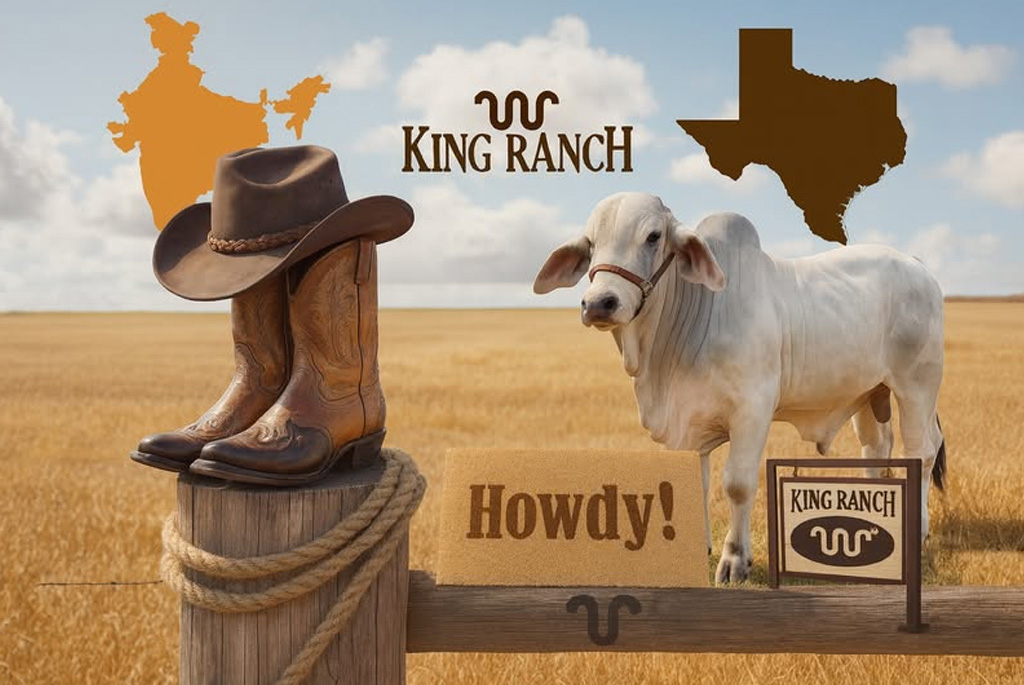
No story on hats and boots is complete without the sound of hooves. Behind every Texan hat is a rancher, and behind every rancher is a cow — often a descendant of one that traveled half a world away. More than a century ago, long before highways crisscrossed the Rio Grande Valley, Brahman cattle from India made their way to South Texas. They were brought to the legendary King Ranch in Kingsville as part of a visionary breeding program. These cattle — with long ears, humped shoulders, and calm endurance — brought a quiet wisdom of the tropics. Their bloodlines helped shape modern Southern breeds, yielding crosses that could thrive where others failed. The King Ranch, with its 825,000 acres, once the largest private ranch in the world, became a laboratory of resilience. As a member of the faculty of Texas A&M University–Kingsville, I’ve long felt indebted to its vision and mission; that pioneering spirit continues to inspire my journey in science and soil.
Lessons Beneath the Brim
If “Howdy” is the voice and “Boots” are the steps, then the “Hat” is the conscience.
Symbol — Represents — Teaches
Howdy — Word — Warmth & equality
Hat — Gesture — Respect & humility
Boots — Action — Work ethic & authenticity
The Global Howdy
Across the world, cultures have their own versions of “Howdy.” In India, it’s Namaste, hands joined in reverence. In Japan, a bow carries the same humility. In Arabic cultures, As‑salāmu ʿalaykum means “Peace be upon you.” The true meaning of “Shalom” goes beyond simple “peace” and signifies a state of being in which all aspects of life are harmonious, including physical health, mental and spiritual tranquility, safety, and prosperity, and it can refer to the relationship between individuals, communities, and God. Different words, same purpose — to acknowledge another person’s humanity. When Prime Minister Narendra Modi addressed the Indian diaspora in Houston in 2019, the event was called “Howdy Modi,” a bridge where Indian heritage met Texan hospitality.
The Philosophy in the Dust
Every greeting, every tip, every footprint carries an invisible philosophy: Speak kindly. Stand tall. Walk true. These aren’t just Texan virtues — they’re universal ethics. Whether you’re a scientist in a lab, a farmer in a field, or a coder in a café, the world still listens to how you greet, not just what you achieve.
Closing Reflection
Someday, the English language may forget many grand words, but I doubt it will forget “Howdy.” Because “Howdy” carries the simplest formula for civilization: a smile, a bow, and a step forward. So next time you wear your hat or lace your boots, start the day with a Howdy. It might not change the world — but it will change the air around you.
The Power of Small Words
“Howdy” is a five‑letter word. It doesn’t take a paragraph to welcome someone — just five humble letters that smile. Some words don’t have to be big, sophisticated, or dressed in grammar to bring a heavenly bliss of meaning. Howdy is one of them. So is “Om” — the shortest sacred sound in the Sanskrit world, said to contain the vibration of creation itself. So is “Namaste” — a seven-letter bow that joins two hands and two souls, whispering “The divine in me honors the divine in you.” And so is As‑salāmu ʿalaykum — a greeting of peace that crosses deserts and centuries, reminding the listener that goodwill must precede every word. We also hear that same music in Shalom — the timeless Hebrew wish for peace, harmony, and wholeness. In each of these greetings, as in Howdy, lies a shared humanity — the instinct to greet before we speak, to connect before we command, and to recognize before we reason. Perhaps the most lasting bridges between people are not built with heavy words, but with light ones — words that fit in the palm of a hand, yet hold the weight of the heart. Howdy, Om, Namaste, Peace, Shalom — brief sparks of divine intention. They remind us that the soul of language is not in its length, but in its love.
“A real Howdy is not from the mouth — it is from the heart, the hat, and the heel. When all three move together, you create respect that echoes beyond Texas.” -Mani Skaria, PhD.