THE DAY I WROTE MY OWN OBITUARY
Insight No. 26
Author: Mani Skaria, Ph.D.
Professor Emeritus, Texas A&M–Kingsville
“Remembering that you are going to die is the best way I know to avoid the trap of thinking you have something to lose. You are already naked. There is no reason not to follow your heart.”
— Steve Jobs, 2005 Stanford Commencement
It wasn’t a funeral.
It was a classroom — a quiet, virtual one, with no walls and only three students — all C-level members of US Citrus company.
Our coach appeared on the screen, calm and deliberate, and said,
“Your next assignment is to write your own obituary.”
The three of us had enrolled together in an eighteen-month, one-on-one management program conducted over the internet. It was rigorous, very costly, and deeply introspective. I expected discussions on leadership, strategy, and growth — not my mortality.
THE UNEXPECTED ASSIGNMENT
At first, the instruction felt unsettling. Why would a management coach ask us to write our own obituaries?
Traditionally, an obituary is simply a public notice of someone’s death — names, dates, and formal facts to inform a community. Over time, however, it evolved into something far richer: a celebration of life. It honors not how a person died, but how they lived — their humor, compassion, struggles, and quiet victories.
Our coach reminded us that this assignment was never about mourning; it was about meaning. Writing an obituary, he said, is like holding up a mirror to see what truly matters when titles, possessions, and praise are stripped away. It’s a quiet test of clarity.
In that sense, the exercise was not about finality — it was about focus. It asked us to celebrate the story still being written and to live in a way that would make the final paragraph worth reading.
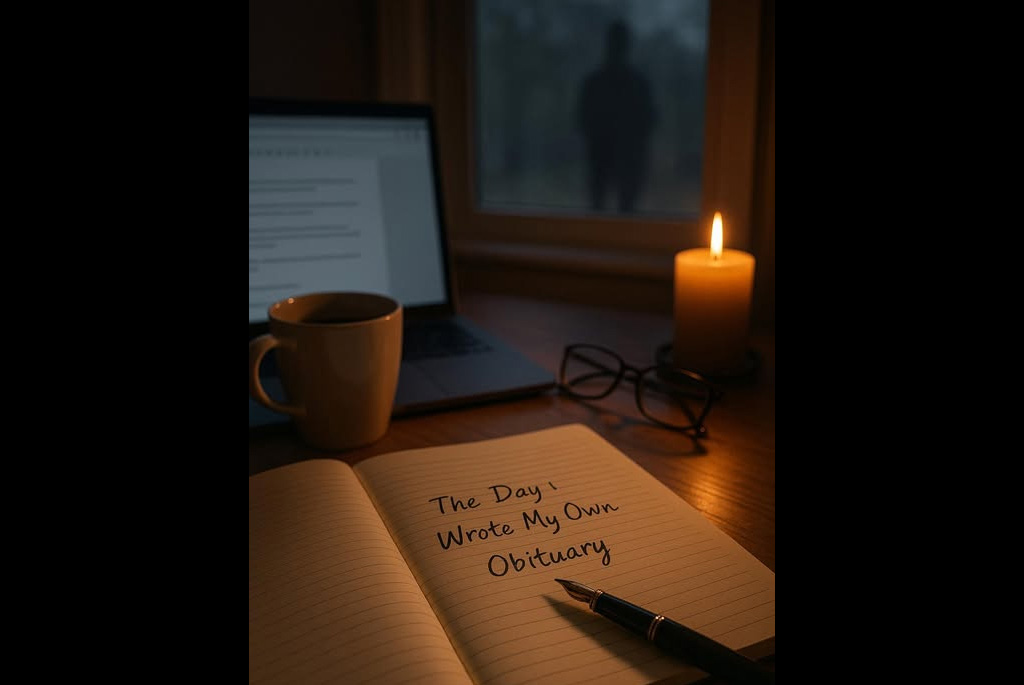
That evening, I sat before my computer, staring at a blank document.
I wrote the title – end of day one and took a three-day break to build strength.
The fifth day I didn’t begin with degrees or achievements; those suddenly felt unimportant. Instead, I wrote about people — students whose curiosity I had helped spark, farmers who trusted my research, and the smart ones that challenged my vision, colleagues who shared my journey, and my wife, son, daughter, Spotty and Peanut — family whose love gave meaning to everything I built. The immediate families of Mani and Anne, and the genetic blue prints we had inherited and we shared with Ron and Amy.
Halfway through, I realized this obituary was not a farewell. It was a mirror showing the life I still wanted to live — my Tomorrow.
It asked softly:
Who am I when the titles fade?
What remains when the applause ends?
Until that moment, I had always known, in a general sense, that anyone can be buried six feet under or turned into ashes within the next twenty-four hours. It was a distant, almost clinical awareness — a truth that applied to “people.”
But while writing my own obituary, that truth became intimate. I realized that I am also part of that group called “anyone.” It was a quiet but profound shift — from knowing mortality as an idea to feeling it as a certainty. And strangely, that realization didn’t frighten me; it grounded me. It made every day that followed feel more precious, more deliberate, more alive.
A few days later, my wife shared a story that made me smile — about a friend who updates their will every quarter.
It struck me as both humorous and profoundly sensible.
Before COVID, I had been invited to give a talk in Dallas on the subject of Success. During the event, I quoted something a magnanimous First Lady once said:
“Your true success is what your family and close friends think about you at your burial.” — Barbara Bush
That statement stayed with me. It reminded me that success, at its deepest level, is not measured by wealth or applause but by peace — peace in our relationships, in our affairs, and in our conscience.
As I reflected on that, I realized I didn’t want to leave any loose ends — in business or in family matters — for my wife or children to struggle with someday. This exercise in writing my obituary quietly transformed into an audit of my life: unfinished promises, unresolved issues, unspoken words. It became not only a reflection on how to live, but also a reminder to keep life in order so that those we love never have to carry unnecessary burdens after we are gone.
In my case, I have an indicator— it is my (big) home office desk is messy or empty!
A MIRROR, NOT A MONUMENT
In business, we are trained to measure success with numbers and charts.
But this assignment had no metrics — only truth.
It revealed that leadership isn’t about being remembered for what you built; it’s about who you lifted and inspired.
That realization quietly changed my view of leadership. True leadership begins where ego ends — at the intersection of humility and meaning.
LESSONS FROM THE EDGE
That one assignment taught me lessons no textbook could offer:
1. Mortality is the ultimate motivator. When time feels finite, focus becomes sharper.
2. Success and significance are not the same. Success fills reports; significance fills hearts.
3. Legacy isn’t what you leave for people — it’s what you leave in them.
Since that day, whenever I plan a project, mentor a young leader, or plant a citrus tree, I pause to ask: Would this be worth a line in my obituary?
THE QUIET GIFT
Writing my obituary didn’t make me anxious; it made me grateful.
It reminded me to slow down, to reach out, to say thank you before it’s too late. It taught me that life, like leadership, is delicate — and that humility is its deepest wisdom.
When I sent that paper to our coach, it didn’t feel like the end of an assignment.
It felt like the beginning of a promise — to live intentionally, to lead with empathy, and to measure worth not by what I achieve, but by what I contribute.
EPILOGUE
Two years passed, that eighteen-month program remains one of the most meaningful experiences of my professional life. My son, the COO; Mr. John, our CFO; and I learned strategy, communication, and financial discipline — but nothing compared to the depth of that single exercise of self-reflection.
It taught me that before managing others, one must understand oneself.
Before building an enterprise, one must build meaning.
“You don’t have to wait for the end to write your obituary. Write it now — and live it forward.”
Because the most powerful obituaries are not written after life ends.
They are written as life unfolds — through every act of kindness, every decision of integrity, and every day lived with purpose.
“Live as if you were to die tomorrow. Learn as if you were to live forever.”
— Mahatma Gandhi