What Is Good Education? From Tagore to Sridhar Vembu: Education Reimagined from the Ground Up
More than a century ago, Rabindranath Tagore—poet, philosopher, educator, and Nobel Laureate— challenged the idea of education as a factory of memorization and examinations. Working from Calcutta and later Shantiniketan in eastern India, he imagined learning as a living process rooted in nature, freedom, creativity, ethics, and joy. He warned that fear suppresses curiosity and that education divorced from life produces efficiency without wisdom.
In contemporary India, at the opposite end of the subcontinent, a quiet echo of that vision can be seen in the work of Sridhar Vembu and his wife, Akshaya Vembu.
Sridhar Vembu is an Indian technologist, entrepreneur, and social thinker—best known as the founder of Zoho Corporation—who has deliberately chosen to shift high-technology work and educational opportunity to rural India. Beyond building a global software company, he has focused on reimagining education, work, and community life through village-centered models that emphasize humility, discipline, self-reliance, and long-term nation-building.
Where Tagore’s experiments took shape in the northeast, my wife Anne and I encountered this modern expression in Tenkasi, Tamil Nadu, in the extreme south of India. The geography is distant, but the philosophical thread is unmistakably connected.
Vembu’s village-based school for young children is not measured by rankings or test scores. Instead, learning unfolds through observation, play, discipline, respect, and engagement with everyday village life. Education is not separated from living; it is embedded in it.
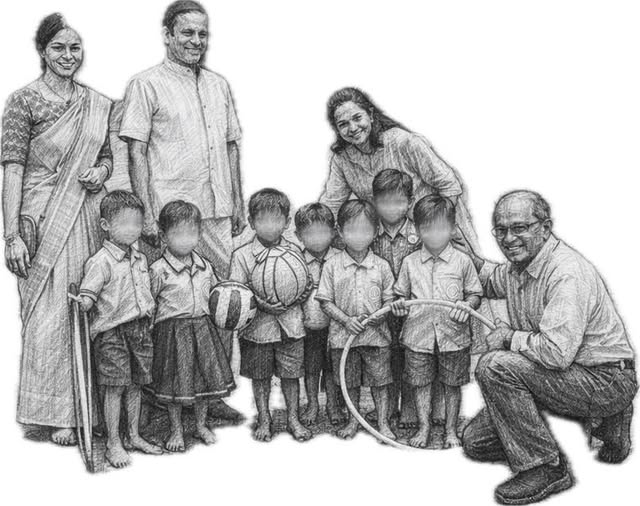
During our visit in November, Anne and I spent time with the children both in the classroom and on the playground, along with both Sridhar and Akshaya. What struck us was the students calm discipline—attentive without fear, respectful without rigidity, and joyful without chaos. There was a quiet confidence in how they carried themselves, something that no syllabus alone can produce.
Some may notice that the children were barefoot and question the practice. It is true—they were not wearing footwear. But this was neither neglect nor compulsion. It was intentional. Sridhar and Akshaya themselves were barefoot, as were others — in fact, Anne and I were the only two in that ground with a footwear. The practice reflects grounding, humility, bodily awareness, and a direct connection with the earth. It is training, not deprivation.
This resonated personally. My son Ron, a trained sports-medicine physician turned farmer, practices walking barefoot regularly in our neighborhood and encourages parents to do the same. He does not walk barefoot all the time; it is a deliberate practice. From a physiological perspective, grounding can influence posture, balance, and sensory feedback. From a human perspective, it reconnects the body to the ground in a way modern life often forgets.
What makes the Vembu model especially compelling is that this village school is not an isolated experiment. It connects to a broader continuum. At the secondary level, Zoho operates the Zoho School of Technology, where motivated students are selected directly from high schools and trained through rigorous, hands-on learning to become industry-ready IT professionals—often without traditional college pathways. Together, the village school and the Zoho School of Technology form a coherent journey: nurturing curiosity and character early, and translating those foundations into competence, dignity of work, and self-reliance later.
The author, Mani Skaria, is a university professor—retired and continuing as Professor Emeritus—who has taught generations of students in traditional classrooms. That education had its place. Today, as his work is increasingly connected to soil, people, fields, and regenerative systems, he sees education through a wider lens. Learning that reconnects mind to body, learner to land, and knowledge to lived experience is not a rejection of scholarship—it is its maturation.
From Tagore in Calcutta to Sridhar in Tenkasi, across a century and across India, the idea endures: education, at its best, grows from the ground up.
—END
Featured Image: A Pencil illustration derived from an original image. The artwork intentionally removes identifiable features of students to ensure privacy, while retaining the educational setting and moment. The adults at left are Sridhar and Akshaya, on the right are Anne and Mani Skaria.