The Doctor Who Built a Heaven Between
Reflections on the Retirement of Dr. Saroja Viswamitra
DHR Health, Edinburg/McAllen
By Mani Skaria, PhD
On February 12, 2026, in McAllen, Texas, nearly 450 people gathered to honor the retirement of Dr. Saroja Viswamitra — Chief Medical Officer, physician, builder, and community healer.
The room was filled with physicians, professionals, civic leaders, and friends. They came to celebrate the rehabilitation centers she established across the Rio Grande Valley and the thousands of lives she touched through decades of service.
It was an evening of recognition.
But as I sat there listening to the tributes, my mind drifted back many years — to a quiet afternoon at the McAllen International Airport.
My wife Anne and I were waiting for a flight. Behind us sat a small group of Winter Texans preparing to return to the Midwest. They were reflecting on their time in South Texas. At first, we paid little attention.
Then their tone shifted.
They began speaking about a doctor.
There was admiration in their voices. Gratitude. Even amazement.
One woman said, “She gives us her cell phone number.”
Another added, “I’ve never had a doctor like this.”
Then we heard the name.
“Dr. V.”
Anne and I looked at each other. Dr. V was not only a respected physician — she was a dear friend of ours. We knew her socially. We had enjoyed her hospitality and her cooking. But we had never visited her rehabilitation centers.
What struck me that afternoon was not praise for her medical expertise. It was the way those strangers described how she made them feel.
They said she listens. They said she follows up. They said she remembers.
In medicine, to remember someone is no small act. It is not merely cognitive skill. It is affirmation.
To remember a patient’s fears, family, and details from prior visits is to quietly say: You matter.
Dr. Viswamitra possesses a remarkable memory. In the entire Valley, I can think of only a handful of individuals with that level of recall — people known for strategic clarity and uncommon mental discipline. But in her case, memory is not simply brilliance. It is compassion in action.
She does not merely remember diagnoses.
She remembers people.
That is why those Winter Texans spoke with such emotion. They knew that when they called her office, they would not become a chart number. They would be recognized. Known. Valued.
And then there is her name — Viswamitra.
In the ancient Hindu tradition, Vishwamitra was a powerful sage. There is a story associated with him that has always intrigued me.
A king named Trishanku sought to ascend to heaven in his mortal body. The gods rejected him and cast him down. As the king fell from the heavens, Vishwamitra saw what was happening and refused to let him be abandoned.
Though not himself a god, the sage used his spiritual power to create a new realm — a heaven suspended between heaven and earth.
It was called Trishanku Swargam — a place in between.
A place for someone who would otherwise fall.
When I think of the rehabilitation centers Dr. Saroja Viswamitra built, I cannot escape that image.What is a rehabilitation center, if not a place in between?
Between illness and recovery. Between weakness and strength. Between despair and hope.
When disease pushes someone downward, when independence feels distant and dignity fragile, a rehabilitation center becomes more than a medical facility. It becomes a bridge.
Not heaven. Not earth.
But a space where a person can rise again.
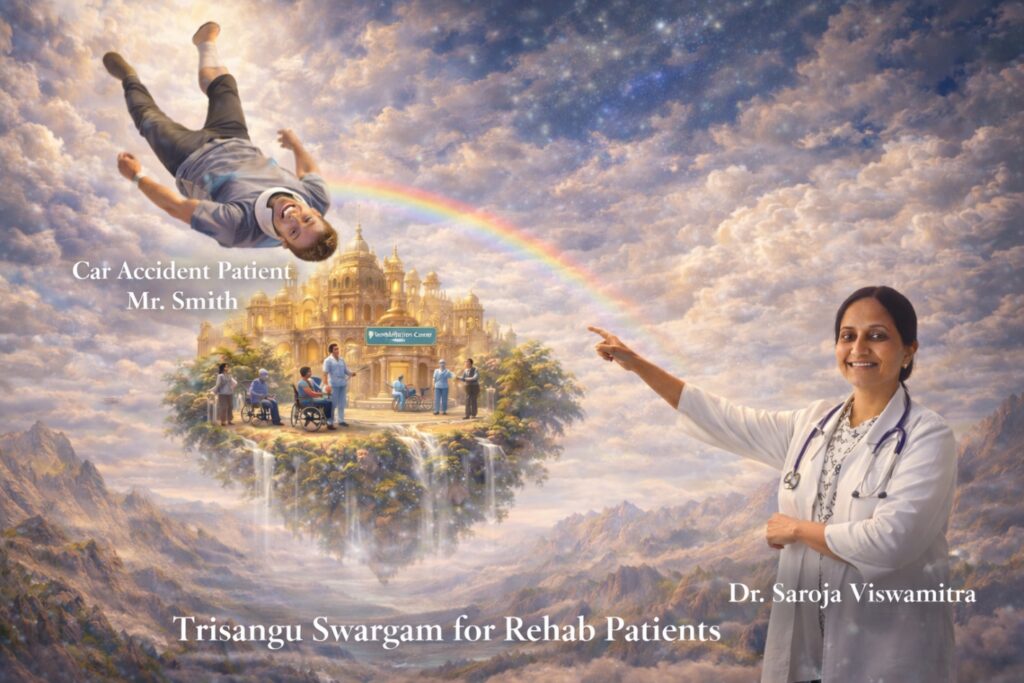
Dr. Viswamitra did not simply practice medicine. She constructed environments where people were given another chance to stand.
Her legacy is not only found in buildings or titles. It lives in quiet gratitude — in restored mobility, regained confidence, and families strengthened because someone was not allowed to fall all the way down.
That is a rare form of leadership.
And leadership does not retire.
It simply finds new soil.
As Dr. Viswamitra transitions from hospital corridors to new ventures — perhaps even coffee fields, as we joked — her essence remains unchanged. Wherever she invests her attention, communities will be strengthened.
Because true leadership is not positional.
It is relational.
It listens. It follows up. It remembers.
And in remembering, it builds heavens in between.
As we honored her retirement, I realized that what 450 people celebrated that evening was not merely a career.
It was a life spent lifting others before they hit the ground.
That is a legacy worth reflecting upon.
And one worth remembering.