
The Inner Circle of Dr. Mani
Opening Late Fall 2026
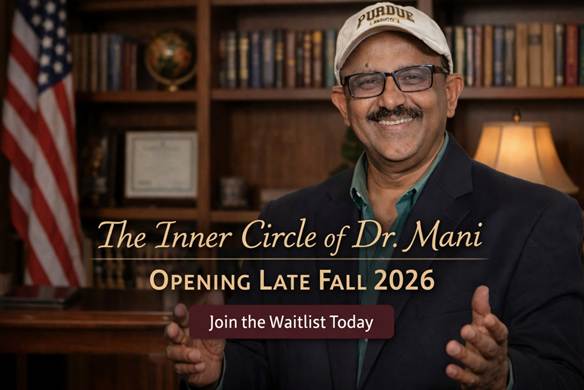
For more than four decades, Dr. Mani’s work has moved across fields, laboratories, classrooms, advisory rooms, and family life.
Agriculture.
Enterprise.
Public health.
Public policy.
Family stewardship.
His reflections on Food, Family, Business, and Society & Citizenship are not commentary.
They are drawn from experience tested in real systems —
in orchards and nurseries,
in university research, extension, education
in legislative reform,
in federal advisory roles,
and at the family table.
The Inner Circle exists for those who value depth over noise.
A Life Walked, Not Theorized
Before coming to Texas in 1988, Dr. Mani served on a USAID agricultural mission in the Jordan Valley of the Hashemite Kingdom of Jordan.
There, he faced a defining moment.
Imported seed potatoes were rotting in extreme desert heat. Though not a potato specialist, he was asked by the Minister of Agriculture to investigate.
Without sophisticated laboratory tools, he began with simple questions:
What is happening?
What are we overlooking?
What is the root cause?
The answer was not disease.
It was soil temperature exceeding 45°C — the seed was being cooked.
From that experience emerged a lifelong principle:
When confronted with complexity, peel the onion layer by layer until the simple truth appears.
This method would guide everything that followed.
Reform Through Observation
When he arrived in Texas, Dr. Mani observed that citrus nurseries across the state were distributing plants carrying latent disease — infections that would only appear years later in growers’ fields.
He documented the data.
He presented the evidence.
The proposal to create a clean citrus program met resistance.
But science prevailed.
In 1997, the Texas Legislature passed a bill — signed into law by Governor George W. Bush — establishing the Clean Citrus Program of Texas.
Since then, more than five million certified clean citrus plants have been produced, strengthening the health and sustainability of the Texas citrus industry.
Reform does not always begin in politics.
It often begins in disciplined observation.
Innovation and Long-Term Impact
Dr. Mani developed:
• A nursery production system reducing plant readiness from nearly two years to under six months
• A high-density planting methodology producing approximately 22 tons of fruit by year three — yields that traditionally required nearly a decade
The economic implications were substantial.
Adoption was not immediate.
Cultural change rarely is.
Years later, growers in other states adopted and refined the system. Variations are now visible internationally.
Innovation does not always return immediate recognition.
Its reward is long-term influence.
When Personal Adversity Became Public Contribution
In the late 1990s, Dr. Mani experienced severe asthma caused by hidden environmental exposure within a building.
Rather than stopping at treatment, he asked:
“What made me sick?”
That question led to research and teaching in human health within the built environment at Texas A&M University.
With university approval, he and his wife operated a laboratory that, over fifteen years, evaluated building damage cases exceeding $1 billion in insurance assessments.
At a time when mold litigation was escalating dramatically, he emphasized a simple truth:
Mold is a symptom.
Moisture intrusion is the cause.
His work contributed to:
• Improved building science practices
• Enhanced school air quality standards
• Legislative reforms in mold-related litigation
Personal illness became public contribution.
Tested in Adversity
In 2020, Hurricane Hanna destroyed a 120,000 square foot state-of-the-art citrus nursery in Texas. Plant inventory valued at $12.5 million was lost.
In 2021, a historic freeze destroyed 145,000 fruit-bearing Persian lime trees contracted to a national restaurant chain.
Two consecutive years.
Two devastating events.
The nursery was rebuilt — stronger, more climate-resilient, and strategically redesigned.
Loss refined the mission.
Leadership Within Institutions
Dr. Mani has served:
• Faculty at Washington State University and Texas A&M University
• Professor Emeritus, Texas A&M University–Kingsville
• Advisor to the Texas Department of Agriculture
• Member (2018–2023), National Agricultural Research, Extension, and Education Advisory Board — advising the U.S. Secretary of Agriculture across two administrations
During his career, he encountered regulatory errors and institutional gaps.
Rather than pursue litigation or outrage, he engaged through disciplined expertise and principled inquiry.
Errors were corrected.
Systems improved.
Frameworks strengthened.
Institutions evolve when experienced individuals participate responsibly.
Family Before Platform
While building enterprises and advising institutions, Dr. Mani and his wife made a deliberate decision.
She remained at home to raise their children while his professional work sustained and grew the enterprise.
Together they raised not only accomplished professionals —
but responsible citizens.
Today, he is a proud husband, father, and grandfather.
Legacy is measured not only in achievement,
but in character transferred to the next generation.
The Philosophy of the Circle
Food.
Family.
Business.
Society & Citizenship.
These are not separate topics.
They are pillars of stability.
The Inner Circle is not a coaching program.
It is not motivational speaking.
It is structured engagement built on disciplined inquiry.
You study the published materials.
You ask thoughtful, specific questions.
And you receive reflections grounded in lived experience — including insights not publicly published, some of which cannot be shared broadly but can be shared responsibly within a trusted circle.
How It Works
- Study the published materials in your area of interest:
• Food
• Family
• Business
• Society & Citizenship - Formulate thoughtful, specific questions.
- A dedicated Inner Circle assistant facilitates communication through a private email channel.
- Questions are reviewed and addressed within the Circle framework.
This is a disciplined inquiry.
Not casual commentary.
Who Is This For?
This circle is for those who prefer substance over spectacle.
It is for:
• Builders who understand systems take time
• Parents who believe character matters
• Entrepreneurs willing to carry risk responsibly
• Professional citizens who value institutions
• Nursery professionals and plant growers
• Organic gardeners
• Fruit tree and vegetable producers
• Agricultural innovators
• Young professionals seeking a grounded perspective
• Individuals and families dealing with building-related asthma, allergy, or environmental exposure concerns
It is not for spectators.
It is for those prepared to read, reflect, and engage thoughtfully.
Who is this not for?
This circle is not for those seeking shortcuts.
It is not for those looking for public debate or quick answers.
It is not for those unwilling to study the material before asking questions.
Depth requires preparation.
Opening Late Fall 2026
Two limited circles will open:
Level One — The Inner Circle
Limited to 2,000 members
One-Year Membership — $145
Level Two — The Private Circle
Limited to 1,000 members
Eighteen-Month Membership — $250
Includes deeper unpublished reflections and greater communication proximity.
Enrollment closes once capacity is reached.
An Invitation Now
If you sense this circle may be part of your future, you may express your intention today.
A $5 refundable intention deposit holds your early position for the Inner Circle opening in Late Fall 2026.
This $5 will be credited toward your membership when enrollment opens.
If you decide not to proceed, it is fully refundable upon request.
Paid securely by credit card through Shopify.
This is not a transaction.
It is an intention.
Express Your Intention — $5 (Refundable)
Closing
This circle is not about following a personality.
It is about engaging with a life that has built, reformed, innovated, endured loss, strengthened institutions, raised a family, and continues to contribute.
For those who wish to make a difference in their own lives —
and in the lives of others —
this circle exists.
Frequently Asked Questions
Is this a coaching or consulting program?
No.
This is not personal coaching, consulting, or a “how-to” training platform.
The Inner Circle is built on disciplined inquiry.
Members study the published materials and submit thoughtful, specific questions.
Responses are reflective and experience-based — not prescriptive formulas.
What makes the Inner Circle different from public content?
Some insights require context, maturity, and trust.
Certain institutional experiences, policy-level observations, and lived lessons cannot be shared broadly in public forums. Within the Inner Circle, those reflections can be shared responsibly.
How does communication work?
A dedicated Inner Circle assistant manages a private email channel.
Members submit questions based on what they have studied within the four pillars:
• Food
• Family
• Business
• Society & Citizenship
Questions are reviewed and addressed within the Circle framework.
This is structured engagement — not casual commentary.
Is the $5 intention deposit refundable?
Yes.
The $5 is fully refundable upon request at any time before enrollment.
If you join when enrollment opens, the $5 will be credited toward your membership.
Are memberships automatically renewed?
No.
Level One is a one-year membership.
Level Two is an eighteen-month membership.
There is no automatic renewal. Renewal options will be offered near the end of each term.
Is there a money-back guarantee?
Yes.
If, within the first 30 days of enrollment, you believe the Inner Circle does not meet your expectations, you may request a full refund.
No debate.
No justification required.
This circle is built on trust.
After 30 days, membership commitments are considered final for the remainder of the term.