The Screwworm at the Gate: Building a Biological Wall Before It Reaches Texas
By Mani Skaria, PhD
Thanks to Dr. T.R. Landford DVM, Deputy Executive Director, Texas Animal Health Commission for his insights that made this article possible.
Confirmed cases of the New World screwworm have now been reported in northeastern Mexico — approximately 230 miles south of the Texas border.
It has not crossed into the United States.
But it is closer than it has been in decades.
That fact alone explains why veterinary authorities, the U.S. Department of Agriculture (USDA), and Texas officials are speaking with renewed urgency. This is not alarmism. It is preparedness.
Because the New World screwworm is not just another insect.
It is a parasite with a long history — and a proven capacity for damage.
A Parasite Known for Centuries
The New World screwworm, scientifically named Cochliomyia hominivorax, has been known to humanity since at least the 19th century. It was formally described in 1858 by French entomologist Charles Coquerel, but ranchers across the Americas understood its devastation long before it was scientifically classified.
The name itself tells the story.
“Screwworm” refers to the larval stage, which burrows into living tissue in a twisting, screw-like motion. “New World” distinguishes it from a related species found in Africa and Asia.
Unlike most fly larvae, which feed on dead tissue, the larvae of Cochliomyia hominivorax feed aggressively on living flesh.
That biological distinction is what makes it dangerous.
What Makes the Screwworm Different
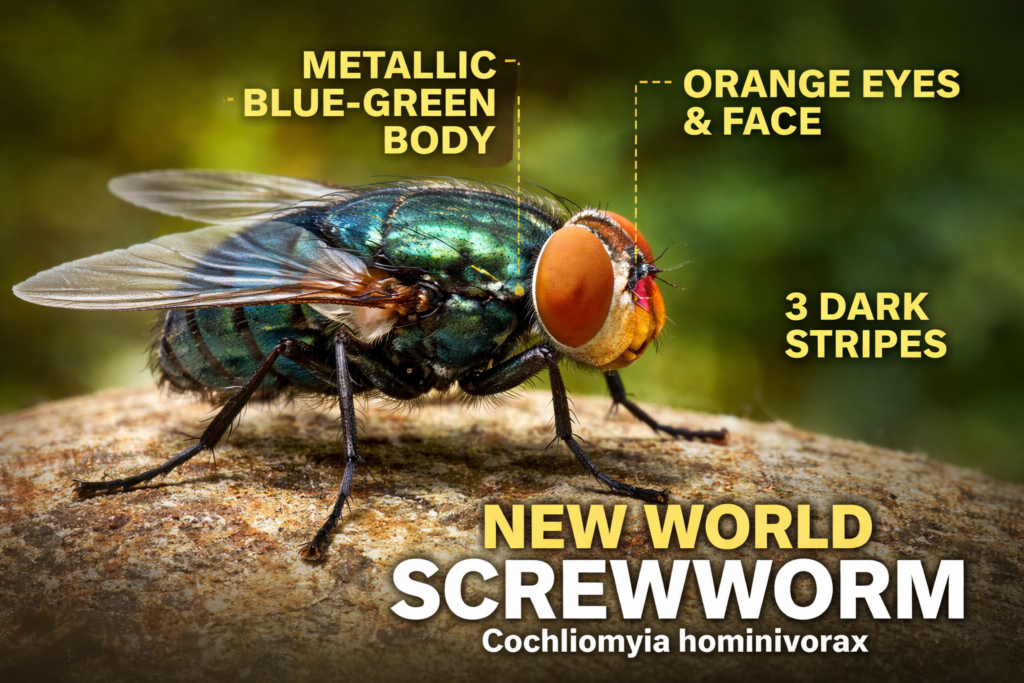
The adult fly resembles a common housefly, though it is metallic blue-green with three dark stripes along its thorax and an orange-tinted face. At a glance, it appears ordinary.
The danger lies in its reproductive behavior.
A female lays 200 to 300 eggs in a fresh wound on a warm-blooded animal. Within 12 to 24 hours, the eggs hatch. The larvae burrow headfirst into healthy tissue, enlarging the wound as they feed.
The result is:
- Rapid tissue destruction
- Severe inflammation
- Secondary bacterial infection
- A strong, putrid odor often recognized before the wound is fully visible
Left untreated, infestations can lead to systemic infection and death.
Cattle, sheep, goats, wildlife, and pets can all be affected. In rare cases, humans may also experience infestation — a condition known as myiasis — typically when untreated wounds are exposed in regions where the parasite is active. Such cases are uncommon and treatable with prompt medical care, but they underscore the insect’s defining trait: its larvae consume living tissue.
In livestock-producing states like Texas, even limited reintroduction could carry serious economic and animal welfare consequences.
A Historic Scientific Victory
The United States has faced this parasite before — and defeated it.
By the early 20th century, screwworm infestations were costing the livestock industry millions annually. The breakthrough came not through pesticides, but through biological science.
Researchers developed the Sterile Insect Technique (SIT). Screwworm flies were bred in controlled facilities, male flies were sterilized using radiation, and millions were released into affected regions.
Female screwworm flies mate only once in their lifetime.
If they mate with a sterile male, their eggs do not hatch.
Release enough sterile males, and the population collapses.
Through coordinated federal, state, and international efforts, the screwworm was eradicated from the United States by the mid-1960s. The containment line was pushed southward through Mexico and eventually to Panama, where a biological barrier has protected North America for decades.
It remains one of the most elegant applications of applied entomology in agricultural history.
Why 230 Miles Matters
Today’s confirmed detections in Mexico — roughly 230 miles from the Texas border — do not mean the parasite is at the gate. But they do narrow the buffer zone.
The screwworm does not recognize political boundaries.
It moves with livestock, wildlife, and favorable climate conditions. Warm environments accelerate its life cycle. In ideal conditions, it can complete development from egg to adult in as little as three weeks.
Unchecked outbreaks create biological pressure.
That is why surveillance matters.
At present, there are no confirmed cases in Texas or elsewhere in the continental United States. But prevention works best before a crisis arrives.
What Government Is Doing
Federal and state authorities are focused on vigilance and rapid response.
Preparedness efforts include:
- Active surveillance and trapping in high-risk areas
- Laboratory testing of suspected larvae
- Cross-border coordination with Mexican and Central American agricultural agencies
- Livestock inspection protocols
- Maintaining sterile fly production capacity for emergency deployment
If necessary, sterile fly releases can be intensified to reestablish a containment zone.
The strategy is proven.
The infrastructure exists.
The question is one of sustained attention.
The Biological Wall
In Texas, the word “wall” carries emotional weight.
But the strongest wall against the screwworm is not built of concrete or steel.
It is biological.
When sterile male flies are released across a strategic geographic band, they create an invisible buffer. Wild females mate, reproduction fails, and the population cannot advance.
It is a pseudo-wall — built from science.
And it cannot function without cooperation.
Supporting outbreak suppression in Mexico and Central America is not charity. It is strategic biosecurity. The earlier infestations are contained, the less likely they are to reach the Rio Grande.
In matters of invasive species and agricultural health, helping one’s neighbor is often the most effective form of self-protection.
Leadership Before Crisis
The New World screwworm is not new.
It is not mysterious.
And it is not unstoppable.
But it demands vigilance.
Biosecurity challenges test whether scientific systems remain funded, whether partnerships remain steady, and whether leaders act before consequences escalate.
The proximity of confirmed cases — 230 miles from Texas — is not a headline designed to alarm. It is a reminder that biological systems operate continuously, whether we watch them or not.
The United States eliminated this parasite once through disciplined science and cross-border coordination.
The same principles apply today.
The most effective wall we can build is invisible.
It is built from surveillance, sterile fly barriers, cooperation, and early action.
And in biosecurity, leadership is measured not by how high we build — but by how wisely we prevent.