Thinking Outside the Box: From Biochemistry to Bloodline
By Mani Skaria, PhD
In the last week of February 2026, I was at the University of California, Riverside, serving in an advisory capacity and speaking with a group of young scientists from across the country. They were serious, disciplined, deeply engaged in laboratory precision — mapping genes, refining biochemical pathways, advancing discovery through controlled experimentation.
During my remarks, I encouraged them to think outside the box.
Later that evening, at dinner, a young scientist sitting next to me challenged that statement.
“What does that mean, exactly?” she asked. “Give me an example.”
I gave an example.
She did not want philosophy. She wanted clarity.
At that moment, I did not give her a satisfactory answer that would connect with her.
But over the following days, the example revealed itself — through something deeply personal.
It began with a coincidence.
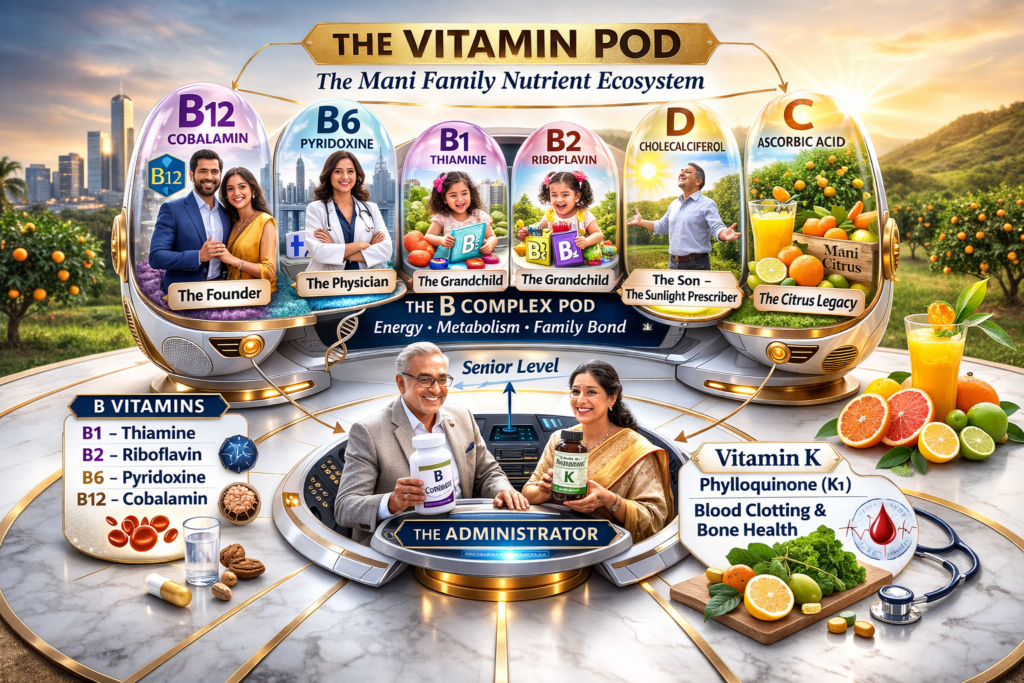
My son-in-law is a co-founder of a New York company called B12. Naturally, I began referring to him as B12 – to me, B12 is a vitamin; for him, it’s meaningful work with AI. What started as wordplay gradually became something more meaningful.
Vitamin B12 — cobalamin — is essential for DNA synthesis, red blood cell formation, and neurological integrity. Without B12, cellular replication falters. Energy declines. Systems weaken quietly.
B12 sustains continuity. It enables renewal. It protects the structure’s integrity.
In many ways, that is what a builder does.
A co-founder creates systems that enable ideas to replicate and grow. A husband joins two family lines, contributing to generational continuity. So when I call my son-in-law B12, it is not just a coincidence — it is recognition.
B12 is married to my daughter, a pediatrician. In my biochemical framework, she became B6.
Vitamin B6 plays a central role in growth, protein metabolism, immune support, and neurotransmitter regulation. It is deeply involved in development and communication within the body.
How fitting for someone whose life’s work centers on the growth and well-being of children.
Then come my grandchildren.
The first, I think of as B1 — thiamine — the spark of metabolic energy. B1 initiates carbohydrate metabolism and helps convert nutrients into usable energy. It begins the cycle.
The second, B2 — riboflavin — supports oxidative reactions and cellular respiration. It contributes to vitality and steady growth.
And yes, between B2 and B6, there is still room for two more Bs.
That line is not biochemical. It is grandfather humor — a laughing-out-of-love message to my daughter. In the B complex, there are more letters. In our family, there is space for more life.
My son took a different path. A physician who transitioned into growing citrus, he is deeply committed to sustainable food production and soil health. For him, Vitamin D feels appropriate — when activated by sunlight, essential for calcium balance and structural strength, linking the sun, the soil, and human vitality.
My wife is iron — Fe.
Iron sits at the center of hemoglobin and carries oxygen through the bloodstream. Without oxygen, metabolism ceases. Movement stops. Life does not circulate – and she is strong!
If vitamins support function, iron sustains existence.
And I am a plant scientist.
So, I chose magnesium — Mg — the central atom in chlorophyll. Chlorophyll and hemoglobin share a remarkably similar porphyrin ring structure. In hemoglobin, iron sits at the center and carries oxygen. In chlorophyll, magnesium sits at the center and captures light.
Change the central atom, and you change the entire system.
In the laboratory, these are isolated molecular functions.
In a family, they become a network.
What makes this reflection even more meaningful is an upcoming journey. Next month, my wife and I will travel to several countries, beginning in Warsaw, Poland.
Poland holds a special place in the history of vitamin science. In 1912, Polish biochemist Kazimierz Funk proposed the concept of “vitamines,” combining vita — life — with “amine,” reflecting the chemical structures he was studying. Though the final “e” was later removed when not all were amines, the essential idea remained: these were vital compounds necessary for life. He was born in Warsaw, Poland.
Life molecules.
It is remarkable that more than a century later, I find myself connecting that foundational scientific insight to something as personal as family and legacy.
There is something else I would want that young scientist to understand.
This exercise was not merely symbolic. It sharpened my own scientific clarity.
To make the metaphor honest, I had to revisit the actual functions of each B vitamin. What distinguishes B1 from B2? What specific reactions require B6? Why is B12 structurally unique among the B complex?
These are not interchangeable letters. They are distinct functional identities within a coordinated system.
And here is where I smile.
I can consume unlimited quantities of B1 and B2.
Large portions. Anytime.
Because in my world, B1 and B2 are my grandchildren.
Science tells us that excess water-soluble B vitamins are excreted.
Love metabolizes differently.
The more B1 and B2 I take in, the stronger I feel.
So, when that young scientist asked me for an example of thinking outside the box, this is what I should have said:
Thinking outside the box is not abandoning science.
It is allowing scientific principles to illuminate life beyond the laboratory.
It is observed that the same structural logic that governs hemoglobin and chlorophyll can also describe roles within families.
Different elements.
Different functions.
One integrated system.
That is systems thinking.
And perhaps, that is the real lesson vitamins were teaching us all along.
Life is interconnected.
And every structure — whether cellular or generational — depends on each part fulfilling its role. In my house, “Fe” is more powerful than “Mg.’
-END-