Harnessing the Power of Vetiver
Today, I invite you to explore an innovative and sustainable approach to citrus cultivation—one that harnesses the natural power of Vetiver grass. Our journey will emphasize our time’s pressing need for sustainable agricultural practices. In this presentation, we will delve into the unique properties of Vetiver, the Latin name Chrysopogon zizaniodes. We will discuss its introduction into our research, explore its role as a companion plant to citrus crops, and highlight the transformative benefits it offers for citrus cultivation in South Texas.
Originating from India, Vetiver has been recognized for its impressive root system, its aromatic oil, and other economic uses. Key figures such as Dr. MentReddy and Dr. Lam Duang at Alabama A&M University significantly influenced my work as early as 2021. Alongside dedicated colleagues like PN Subramanyan, Pathanjali Jha, and those from Vetiver International, their involvement has helped elevate this powerful grass in agricultural practices at US Citrus today. My special appreciation to Mr. Jacs Rao for the invitation to present this information at this meeting in Raipur.
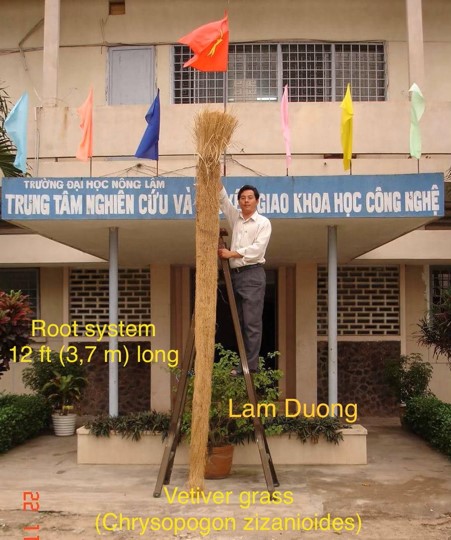
My experience at Alabama A&M University opened my eyes to the potential of this plant. This image of Dr. Lam standing proudly beside a 12-foot Vetiver plant root system served as a pivotal moment in my realization of its importance.
Most people in India know of the economic value of Vetiver oil and its cooling effects in hot climates. I recall that in Kerala, farmers once employed contour planting of Vetiver for soil stabilization—a practice that sadly faded from memory.
Vetiver’s essence extends beyond agriculture, featuring prominently in products like Royal Gold Cream, where its fragrant oil is cherished in cosmetics.
Vetiver’s role in citrus cultivation, as we practice in Texas, is new but multifaceted: (i) it provides wind protection, acting as a natural barrier against strong winds that can harm young trees. (ii) It creates a physical barrier to pests, protecting young citrus leaves from infestations such as the Asian citrus psyllid and mealybugs.
As a bio-mulch, Vetiver clippings can suppress weeds and retain soil moisture—a critical asset, especially during drought periods.
In 2024, South Texas faced unprecedented drought conditions, making our experiments with Vetiver essential. We observed that citrus trees planted alongside Vetiver demonstrated remarkable survival despite limited watering. That year marked over 50 days with temperatures exceeding 100 degrees Fahrenheit. Remarkably, our citrus trees, positioned between Vetiver, thrived under such extremes.
Furthermore, in January 2025, we faced tree-killing temperatures. Our young grapefruit tree survived the freezing weather, unlike many trees not protected by Vetiver. They thrived through these temperature extremes and were notably protected against damaging freezes.
An interesting example of harnessing the Vetiver plant occurred post-freeze; we used heavy mulchers to clear dead citrus trees. Remarkably, the Vetiver plants adjacent to them regrew splendidly, as shown in the video.
To promote Vetiver in South Texas, we launched community initiatives during the 2022 and 2023 Earth Day Celebrations, distributing Vetiver plants to high school students and local officials. Here, we actually see a City Mayor and a County Judge, who carries Vetiver plants to grow in their homes. The celebrations were even featured by a Malayalam TV Channel in Kerala, combining environmental awareness with cultural outreach.
Working with platforms like the Kerala TV Channel 24 during Earth Day has amplified awareness about Vetiver’s benefits, solidifying its role in our environmental efforts.
Looking ahead, our goals include integrating Vetiver as a standard practice in citrus farming. Following the tragic landslides in Wayanad in 2024, I aim to distribute a million Vetiver plants in Kerala, with support from high school students and the community. This effort aims to enhance awareness of Vetiver for soil stabilization, particularly in landslide-affected regions.
To conclude, adopting Vetiver can be a game-changer for sustainable agriculture. I encourage fellow growers to explore this innovative approach. With support from our collaborators and partners, we can nurture healthier ecosystems for future generations.