A HALF CHAPATI MEMORY — From Bombay to Pune
Insight No. 25
Author: Mani Skaria, Ph.D.
Professor Emeritus, Texas A&M–Kingsville
“Do not blame your food because you have no appetite.” — Rabindranath Tagore
A PERSONAL REFLECTION ON INDIA’S ANCIENT FLATBREAD
Yesterday, my wife and I had lunch at the Taj Hotel in Bombay — the city where I first arrived decades ago as a young scientist, full of dreams and curiosity. Each return to this soil humbles me through the simplest of moments.
The waiter at the Shamiana restaurant approached with quiet grace, carrying a single chapati — warm, soft, and wrapped in a thick cloth the same hue as the bread itself. The aroma of freshly baked wheat filled the air, and for a brief moment, time seemed to pause. That humble chapati carried me back to a lunch in Pune, in 2014, where a memory was quietly baked into my heart.
A decade ago, I traveled to Jalgaon, the headquarters of Jain Irrigation — one of India’s great contributions to sustainable agriculture. During that visit, I stopped in Pune to meet and greet a remarkable scientist, Dr. Vijay Bhatkar, the visionary appointed by Prime Minister Rajiv Gandhi to lead India’s first supercomputer project. I had been introduced to him through his brother, Awinash a close friend of mine. Sitting across from Dr. Bhatkar, I felt a deep sense of privilege. Every sentence he spoke carried decades of wisdom shaped by both technology and philosophy — the architect of PARAM supercomputing, Padma Bhushan, Chairman of IIT-Delhi, and more.
When his cook brought the chapatis — one at a time — each was wrapped in cloth and presented with reverence. Dr. Bhatkar broke it in half, offered me a piece with a calm smile, and kept the other half for himself. The act was deliberate, almost ceremonial — a quiet dialogue on humility, equality, and gratitude – there was no hierarchy.
The vegetable dishes on the table were simple yet pure and mesmerizing. The cook watched our rhythm — the rise and fall of conversation, the silences between insights — and seemed to know exactly when to bring the next chapati. It was not merely lunch; it was a choreography of respect. I have dined at many memorable tables, but that day’s meal felt sacred.
I wanted to ask, “Why half a chapati at a time?” Yet I could not disturb the serenity of that moment. I simply absorbed its meaning — the silence, the grace, the message behind each motion.
When lunch ended, Dr. Bhatkar asked about my next destination. On hearing that I would visit Jain Irrigation, he immediately called Mr. Bhavarlal Jain, the legendary founder. His call opened a door I had not even knocked on — a meeting with the man who transformed India’s irrigation landscape and touched lives far beyond its borders. Originally, a meeting with Bhavarlalji was not in the program, but I was lucky to have 30 minutes of private audience with him. He did not talk about drip irrigation but about how he insists his employees drink milk at work!
That afternoon, I left Pune deeply moved — not by grandeur, but by the quiet power of a half chapati.
THE CULTURAL INSIGHT OF CHAPATI
For years, the question Why half a chapati? lingered like a seed in fertile soil. It sprouted again today, as the waiter at the Taj hotel placed a single chapati before us. I realized the gesture was not about portion or economy. It was a language — a silent expression of equality, mindfulness, and connection.
In India, food is rarely just sustenance; it is communication. A chapati wrapped in cloth and shared half-and-half becomes a message of balance: I share what I have; we are equals at this table. The cloth keeps the bread warm, but it also symbolizes care — protection from haste, respect for nourishment, and gratitude for the unseen hands that prepare and serve.
Even in luxurious settings, this quiet tradition endures. It reminds us that the true richness of Indian dining lies not in abundance but in reverence — for the guest, the grain, and the act of sharing.
A JOURNEY BACK TO THE ORIGIN
That one chapati — whether shared in a Pune home or served in a Bombay hotel — connects us to one of the world’s oldest food traditions.
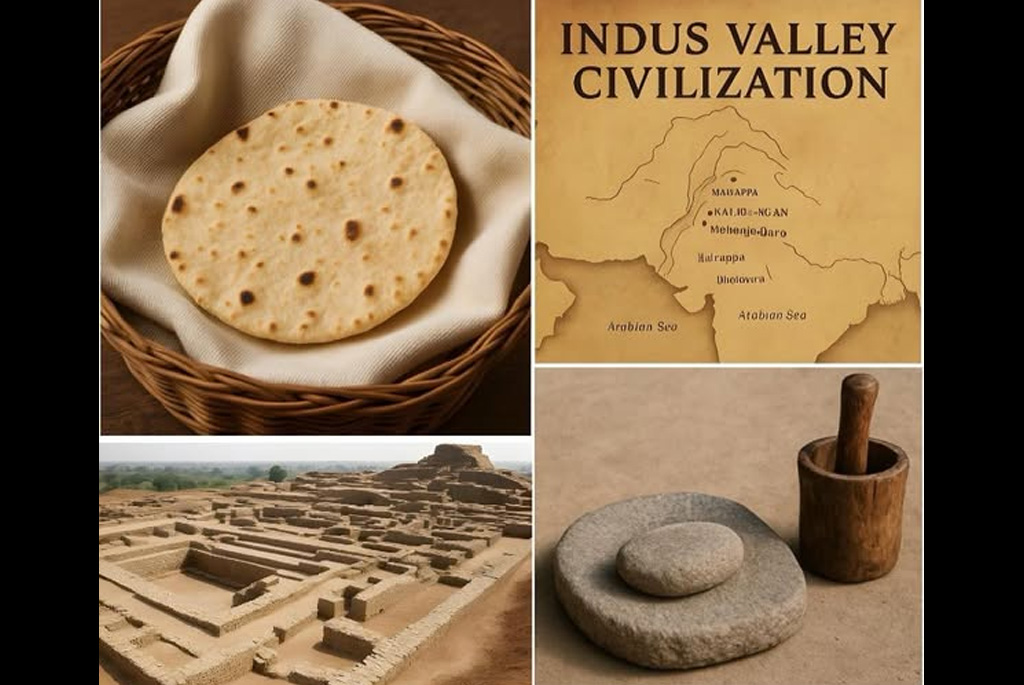
Archaeological discoveries trace chapati’s ancestry to the Indus Valley Civilization (2600–1900 BCE), where wheat was among the first domesticated grains. Flat stones and primitive griddles found in ancient hearths reveal that early farmers were already making unleavened wheat breads — the direct ancestors of today’s chapati.
The word chapati comes from chapat, meaning “to flatten or slap,” echoing the rhythmic hand movements that still fill Indian kitchens. From the fields of Punjab to the courts of Mughal emperors, chapati has remained the bread of the people — simple, nourishing, and unifying.
Thus, when my wife and I broke that single chapati at the Taj, we were not merely dining — we were participating in a 4,000-year-old continuum. From the hearths of the Indus Valley to modern India’s tables, the chapati has carried the same message: nourishment is sacred, sharing is divine, and simplicity can hold the depth of civilization itself.
“When we break a chapati, we are not dividing food — we are multiplying gratitude.”
— Dr. Mani Skaria
THE UNIVERSAL BREAD OF HUMILITY
Across cultures and faiths, the simple flatbread holds a sacred place. The Indian chapati — made from whole wheat and water — shares its soul with the unleavened bread of the Jewish Passover and the bread broken by Christ at the Last Supper. None depend on yeast or luxury; they rise only through the warmth of human hands and the fire of simplicity.
Born of haste, humility, and gratitude, these breads remind us that nourishment need not be ornate to be holy. Whether offered to God in Jerusalem or shared in an Indian kitchen, each round becomes a circle of faith — linking civilizations through the most fundamental act of love: sharing one’s daily bread.
So next time someone offers you half a chapati, pause before you eat. You may be receiving not half a bread — but a whole tradition.