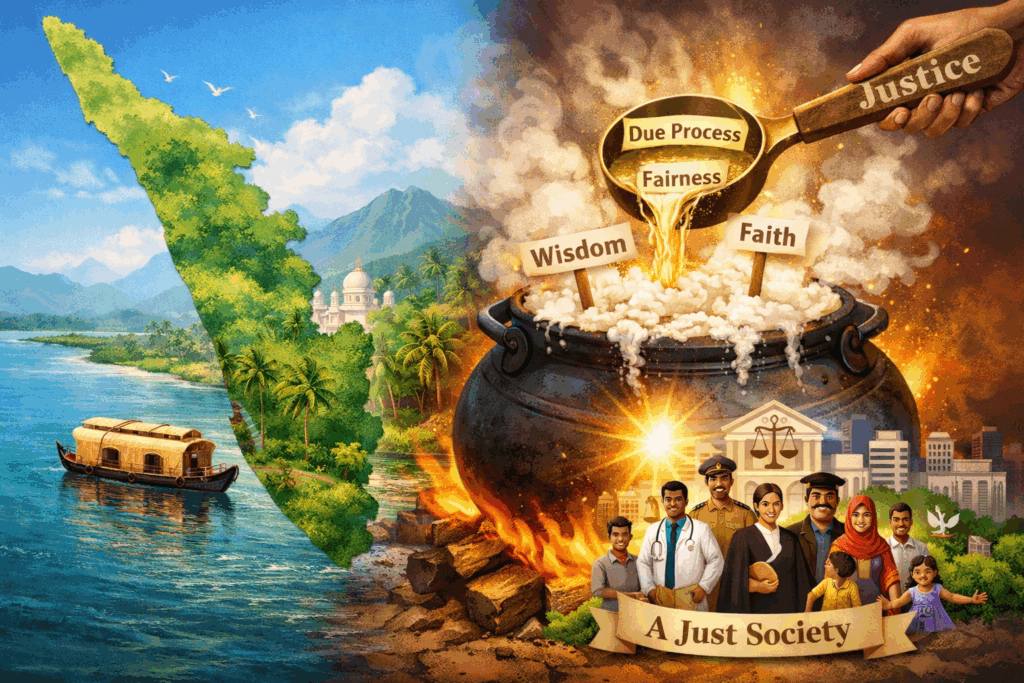
Kerala, Social Media, and the Quiet Disappearance of Due Process

Kerala, Social Media, and the Quiet Disappearance of Due Process
By Mani Skaria, PhD
Kerala is a state that takes pride in thinking aloud. Its high literacy, political awareness, and culture of debate have long been sources of strength. Public discussion here has never been passive; people question, argue, and challenge authority. But in the age of social media and round-the-clock news, this strength is beginning to reveal a dangerous weakness.
At the center of this shift is the quiet erosion of due process.
Due process is often mistaken as a technical legal concept. In reality, it is a moral discipline. It asks society to pause before judging, to separate allegation from proof, and to allow facts to emerge before conclusions are drawn. It exists not to protect the powerful, but to protect everyone from irreversible harm caused by premature condemnation.
Today, that discipline is under strain.
Across social media platforms, YouTube channels, and prime-time television debates, allegations are increasingly treated as verdicts. Private lives become public trials, driven by outrage, speculation, and the race for attention. Speed is rewarded; restraint is not. Silence is interpreted as guilt, and complexity is flattened into hashtags and headlines.
Sympathy for the vulnerable is essential in any just society. Kerala is right to stand with those who have historically been unheard. But sympathy, however sincere, cannot replace investigation. Emotion cannot substitute evidence. When public feeling becomes the basis for judgment, justice becomes selective and fairness collapses.
The result is not accountability, but fear—fear that reputation can be destroyed overnight, and that correction, even when it comes, will never travel as far as accusation.
Media and social platforms wield immense power. With that power comes responsibility. When attention and revenue begin to outweigh truth, due process is quietly sidelined. And when due process weakens, trust in institutions erodes, leaving society more anxious, more polarized, and less fair.
Kerala’s literacy has given its people valuable abilities: the capacity to read, to consume information, and to speak and argue with confidence. But literacy alone does not guarantee wisdom. It does not automatically teach restraint, fairness, or ethical judgment. Those must be consciously practiced.
An educated society is not necessarily a just one.
This is not a call to silence criticism or suppress voices. It is a call to slow down—to ask better questions, to distinguish allegation from proof, and to allow justice the time it requires. Justice delayed may be painful, but justice rushed is often irreversible.
If Kerala can remember this—amid the screens, the debates, and the outrage—it will not just remain a literate society, but a just one.
This article and an accompanying video will be archived at https://drmanisinsights.com/