MANI’s VISIT to MANI BHAVAN in MUMBAI: A Reflective Journey Through a Living History
Insight No. 31
Author: Mani Skaria, Ph.D. (the Silly Goose Grandpa)
Professor Emeritus, Texas A&M–Kingsville
Prepared on November 19, 2025
Yesterday, my wife Anne and I (first name, Mani) stood before a quiet, dignified building called Mani Bhavan on Laburnum Road in Mumbai. The wooden balconies, iron railings, and filtered sunlight made the façade almost glow. This was “Mani Bhavan” the home where Mahatma Gandhi lived and worked between 1917 and 1934, during some of the fiercest years of India’s struggle for independence.
As I stood by the plaque, I felt a connection that was more than tourist curiosity. My own name—Mani—suddenly echoed the meaning as our private tour guide had shared: “In Marathi, Mani means “jewel.”
I smiled, as I noted my wife heard it, but Anne did not completely believe the guide’s etymology, but the story stayed with me nonetheless. For me, the name now connected — however lightly—to a place where ideals were forged and tested.
WALKING THE WOODEN FLOORS
Stepping inside, I walked across the same wooden floors that Gandhi once paced in deep thought. I imagined Gandhi planning the Non-Cooperation Movement, Satyagraha, or preparing the speeches and letters that would ignite the nation’s conscience. These rooms had once heard conversations that shook the British Empire.
There was a stillness to the house. A kind of dignity. I felt that Gandhi’s simplicity—his weaving, his silence, his discipline—had been absorbed into the walls themselves.
HISTORY LINKING PAST AND PRESENT
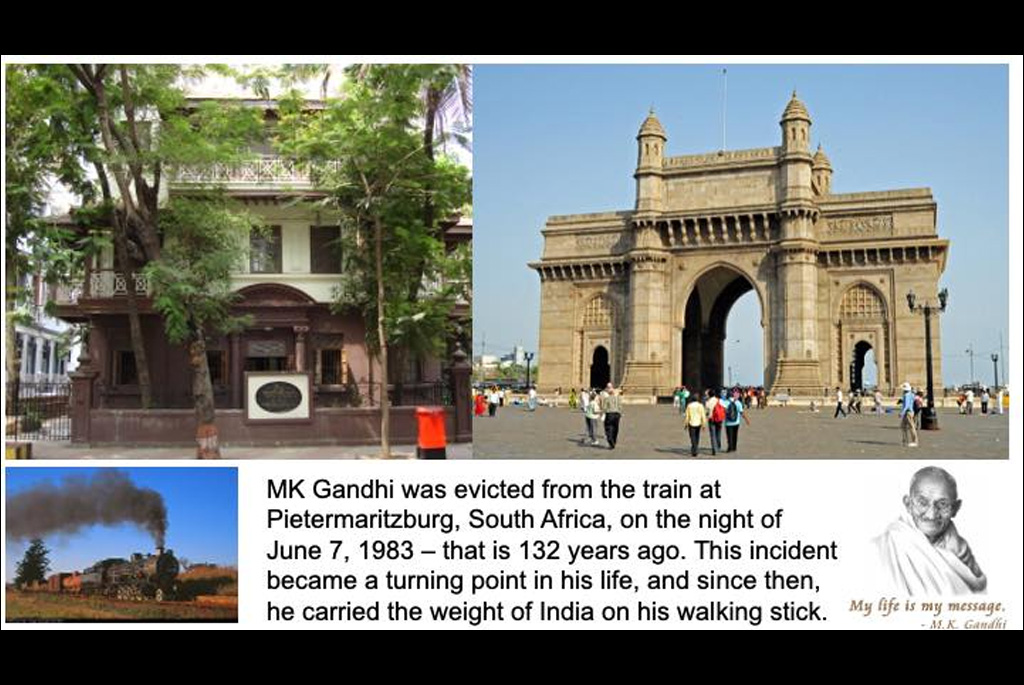
Later, standing before the Gateway of India, less than three kilometers away, I recalled another historical thread. It was through this arch that the last British soldiers left India in 1947, symbolizing the end of a 200-year chapter. The blue print for the exodus was cooked in the Mani Bhavan – Mohandas Karamchand Gandhi was the architect.
To me, the 2.6 kilometer distance from Mani Bhavan to the Gateway of India was not just physical but emotional. One was the birthplace of movements—the other, the final exit place of the colonial era. Together, they formed two bookends of a nation’s awakening.
I ALSO WALKED THE SOIL — THE VERY BIRTHPLACE OF GANDHI’s TRANSFORMATION.
Having visited the Pitermarisburg train station in South Africa 30 years ago I close the dots here today. Attorney MK Gandhi was thrown out of a train in Petermarisburg for traveling in a first class compartment with a valid ticket and wearing western clothes. However, his skin color was not aligned with South African Railway policies. That incident transformed Gandhi from a first-class train traveler in suites to a half- naked walker with a stick, carrying the weight of a poor nation under the British Rule.
A TOUCH OF HUMOR: “Sir George”
My tour guide affirmed that Mani = Jewel. My wife, Anne heard it with no emotions on her face.
I recall a humorous anecdote I once heard directly from President George H. W. Bush in a small gathering.
Bush had shared how he was awarded an honorary knighthood by Queen Elizabeth II. It happened on 30 November 1993, when he was invested as Knight Grand Cross of the Order of the Bath (GCB)—the highest British honor for a foreigner.
Bush joked that although he was now “Sir George,” his wife Barbara absolutely refused to call him that. A week after the royal ceremony she asked, “George, please take the kitchen garbage out!”
She did not call him, Sir George!
Even with knighthood, some things at home never change.
It is reminder that titles may impress the world, but true greatness is always grounded in humility.
HIGH IDEALS
Two weeks ago, Anne and I had the privilege to walk through another meaningful place—a farm in Tenkasi—along with a man who also believes in simplicity and high ideals: Sridhar Vembu of Zoho.
The contrast struck me: on one side, Gandhi’s legacy housed in Mani Bhavan. On the other, a modern IT pioneer quietly shaping a rural India through knowledge and empowerment living in a village in Tenkasi in Tamil Nadu, India.
“Humanity needs a lot of people with high ideals mixed with humility.”
That line, written in my head notebook, tied both journeys together.
A VISIT THAT BECOMES A MEMORY
As Anne and I stepped away from Mani Bhavan, I carried with me more than photographs. I carried reflection—about history, humility, courage, and the quiet power of high ideals. My visit became not just a stop on a Mumbai itinerary, but a moment of connection: between name and meaning, between past and present, between a humble house and a global legacy.
And perhaps that is the real jewel—that Mani—that I carried home from the Mani Bhavan.
Thank you for reading.