The Longest Queue of Hope and the Divine Bottle
Insight No. 21
Author: Mani Skaria, Ph.D.
Professor Emeritus, Texas A&M–Kingsville
A humorous reflection on Kerala’s most disciplined citizens and their two state-sponsored devotions.
In the past week, I’ve written about everything from Food to Nobel laureates to motherhood to the fine art of bending low to rise high. So, I thought it was time to give my brain a holiday — and pour out something lighter with a touch of Kerala humor and liquor flow in perfect discipline.
_________________________________________________________________
The Paradox of Discipline
In Kerala, discipline is a seasonal phenomenon. At the railway station, people rush like it’s an evacuation drill. At the cinema, elbows are weapons of mass impatience. At wedding buffets, the rule is simple—whoever reaches the biryani first wins – the survival of the fastest!
Yet outside a government liquor shop—behold!—a scene of calm, order, and quiet meditation. The most disciplined line in Kerala stands not for a temple blessing or a ration card, but for the Divine Bottle.
The State That Sells Sin — and Taxes It Kindly
In most parts of the world, governments handle education, health, and housing. In Kerala, they also manage happiness and hope—through liquor and lottery. One gives you instant joy, the other sells you the dream of joy. Both end with the same message: “Thank you for your generous contribution to the state exchequer.” In a land that debates morality over tea, it is the government itself that pours the drink and prints the dreams.
The Divine Bottle
Every morning, before the shutters rise, faithful devotees gather in quiet reverence. The ritual is ancient, the order divine. No pushing, no shouting—only anticipation. For a few precious minutes, chaos bows before discipline. It’s not just a queue; it’s Kerala’s unofficial temple of tolerance, where everyone is equal before the bottle.
The Spiritual Touch
And what truly elevates this ritual is the Kerala devotion to Ganapati. In this land, every good thing begins with a small offering to the elephant-headed god. So, when the bottle is opened, take a respectful drop on the finger and offer it to Ganapati. It’s pure devotion:
God first, peg next.” Faith with flavor, devotion with a dash. Only in Kerala can theology and oenology blend so harmoniously.
The Sacred Science of “Tottu Kuttan(s)”
Of course, no experience is complete without the sacred companion—the tottu kuttan. In Malayalam, tottu means “to touch,” and kuttan means “a little bite.” It could be a lamb pickle, a fiery sardine fry, or a sliver of something that wakes the senses. With the pointed finger, a small touch is taken—just enough to spark the tongue—then the sip follows. In that tiny gesture, chemistry meets culture. The taste, the heat, and the spirit combine to produce a small, private ecstasy. You don’t need philosophy when you have such precision in pleasure.
The Longest Queue of Hope
A few streets away, another line forms—this one for lottery tickets. Each ticket is a prayer folded in paper, sold with a smile that says, “Today might be your day.” The odds of winning are roughly the same as spotting a snow leopard in tropical Kottayam, Kerala, but nobody minds. Hope, after all, doesn’t require logic—only faith and forty rupees in the pocket.
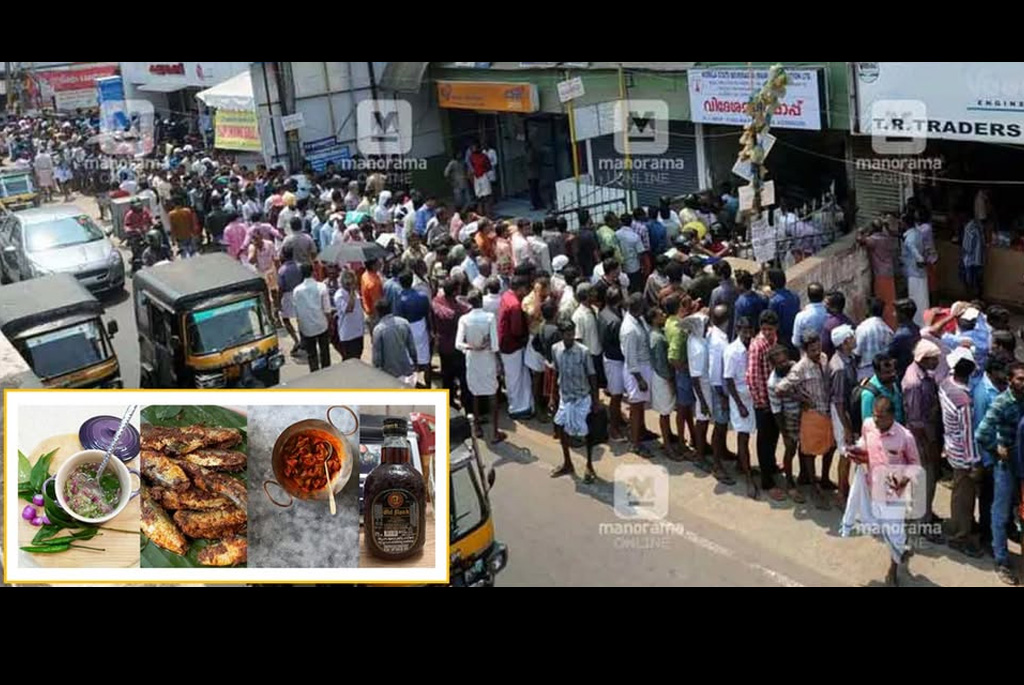
Disciplined line in front of a state-operated liquor shop in Kerala (Photo: Manorama Online). Picture (insert): Author’s rendition of tottu kuttans — chutney for the tongue, sardine fry for the heart, pickle for the soul, and Old Monk for the courage to face tomorrow — and, of course, the hope of winning a lottery ticket.
The Economics of Emotion
Liquor offers temporary happiness. Lottery offers imaginary happiness. The government enjoys permanent happiness through taxes. It’s a perfect model of emotional socialism: the people supply passion, the state collects revenue, and everyone sleeps satisfied.
The Festivals of Flow — Onam, Christmas, and Beyond
Then arrive the seasons of abundance—Onam, Christmas, Diwali, and the wedding months. The Onam Bumper becomes the annual jackpot; Bevco (liquor) outlets overflow like the Pamba river during monsoon; and the treasury smiles—fat and festive. During Onam, it’s said that even Mahabali might queue for a peg before his royal lunch. At Christmas, devotion deepens—both in church and at the counter. And at weddings, the toast is not merely to the bride and groom but, indirectly, to the state budget. Kerala doesn’t just celebrate festivals—it funds them beautifully. Every festive season becomes a merger of faith, family, and fiscal planning.
The Psychology Behind the Queue
Maybe Keralites are not impatient—they are selectively disciplined. When the reward is spiritual (Ganapati), liquid (Bevco), or lucky (lottery), order emerges naturally. But when it’s a train ticket or a movie seat, philosophy takes over: “Why rush? What is meant for you will come… maybe in the next show.” It’s not laziness; it’s destiny management.
The Kerala Model of Hope
So perhaps the secret to Kerala’s calm isn’t just literacy or governance. It’s this unique social chemistry—a bottle of discipline, a ticket of faith, a touch of devotion, a tottu kuttan of pleasure, and a festival of spending. The Divine Bottle teaches patience. The Longest Queue of Hope teaches optimism. And somewhere, Ganapati smiles, receiving his sacred sip—keeping Kerala perfectly balanced between heaven and happy hour.
“Faith, flavor, and fiscal discipline — Kerala found a way to bottle all three.” -Mani Skaria
____________________________________________________________________
Mani Skaria is a Professor Emeritus, citrus grower, and keen observer of human nature—one who also appreciates the art of the tottu kuttan. Two years ago, while in Kerala, he was tempted to stand in the legendary liquor queue himself—purely for research—but his driver firmly refused. The Professor, uncharacteristically, yielded.