WHEN A PAPAYA LOOKS RIGHT – BUT DOESN’T TASTE RIGHT
By Mani Skaria, PhD.
Last week, I cut a papaya I purchased here in McAllen, Texas. It looked perfect—nice color, good shape, good firmness. But the first bite was disappointing: watery, diluted, almost flavorless. It looked like papaya… but it didn’t taste like papaya.
I purchased it to impress my toddler granddaughter, but failed!
This took me back decades to my childhood in Kerala, India, where papaya was one of my favorite fruits. Back then, we didn’t have modern commercial breeding lines. Yet papaya in our backyard was almost always sweet and satisfying.
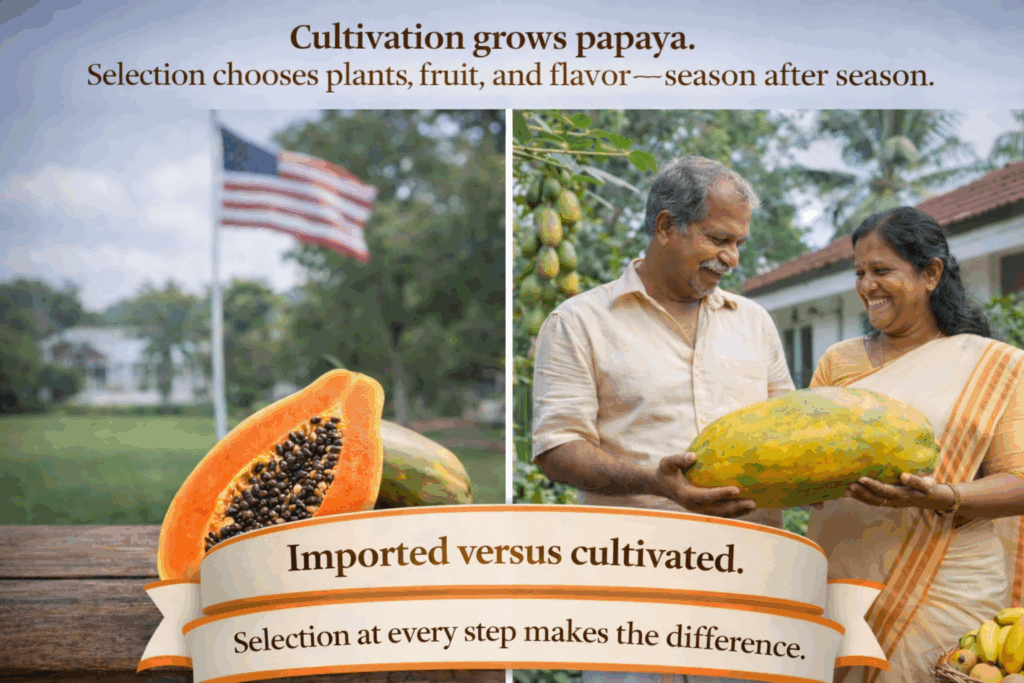
Here’s why: Papaya is genetically diverse. When you grow papaya from seed, you can get female, hermaphrodite, or male plants – some plants produce good fruit. Families would cull the unwanted plants early. Once the plant produced fruit, its quality declared itself—within the first year, you knew which plant was perfect. We kept the best and removed the rest. And most importantly, we did not rush to harvest. We picked papaya when it was truly ripe.
A few years ago, I experienced that “real papaya” again during a visit to a senior friend in Homestead, Florida. He served papaya for breakfast, and it was outstanding—sweet, rich, memorable. This gentleman is not an average papaya taster. He built a tropical fruit business of roughly $60 million in annual revenue at that time and owned a large plantation of Red Lady papaya in Central America.
I asked him the obvious question: Why does your papaya taste so good when so many papayas in the store don’t?
His answer was simple and scientifically correct: “It starts with the seed.”
He explained that true-to-type papaya grown from pure, reputable seed sources performs better. But he emphasized something equally important: harvest timing. If papaya is harvested too early for shipping and shelf life, the sugar never fully develops.
In scientific terms, that is °Brix (a measure of natural sweetness).
• Good papaya: about 12–17° Brix
• Early-harvested papaya: low Brix → watery taste, no matter how it looks
The story didn’t end there. The next day after my visit, he sent me a papaya by FedEx. I called and thanked him—then joked, “One is not enough.” A couple of days later, a large box arrived by UPS. Every fruit was consistent—sweet, aromatic, and satisfying. No luck involved.
This is also where policy matters. Unlike fruits such as grapefruit, papaya has no active federal marketing order in the USA and no system-wide eating-quality benchmark. Much of our papaya is imported, and standards tend to focus on safety and logistics rather than flavor. The result is what many consumers experience: papayas that look right, ship well, meet safety rules… but often don’t taste right.
Takeaway:
Good seed + healthy plants + right harvest timing = good °Brix = authentic papaya flavor.
Have you had the same experience—sometimes a grand papaya, sometimes a watery one?
#Papaya #FoodQuality #SeedQuality #Brix #HarvestTiming #FoodSystems #Agriculture #ConsumerTrust