Who Will Grow Food for Kerala? (Malayalam)
Educated, Global …. Yet Food-Dependent!
By Mani Skaria, PhD
Kerala is a narrow strip of land, cradled between the Western Ghats and the Arabian Sea.
A long coastline.
Backwaters that breathe with the tides.
Monsoon-fed rivers that descend from mist-covered mountains.
It is a land of coconut palms, paddy fields, tea gardens in the high ranges, and spices that once drew traders from across the world — cardamom, black pepper, cloves. For centuries, Kerala was known not merely as a consumer of food, but as a producer of value from the soil.
Today, Kerala is known for something else.
Nearly 100 percent literacy.
A global diaspora.
Doctors in the United Kingdom.
Nurses in the Middle East.
Engineers in North America.
Academics across continents.
With a population of approximately 33 million people, Kerala has invested deeply in human capital. Education is its proudest achievement. Remittances from overseas workers form a powerful pillar of its economy. It is, in many ways, a model of social development.
And yet, there is a quiet paradox.
Kerala produces talent for the world — but depends on other states to feed its people.
A significant portion of rice, vegetables, pulses, and fruits consumed in the state comes from neighboring regions. Tamil Nadu, Karnataka, and Andhra Pradesh play critical roles in Kerala’s food security. The state that once grew abundantly now imports substantially.
This is not an accident. It is the result of structural shifts.
Some years ago, I had the opportunity to spend early morning time walking with a former Minister of Agriculture. Away from the microphones and conference halls, he spoke candidly about his concerns.
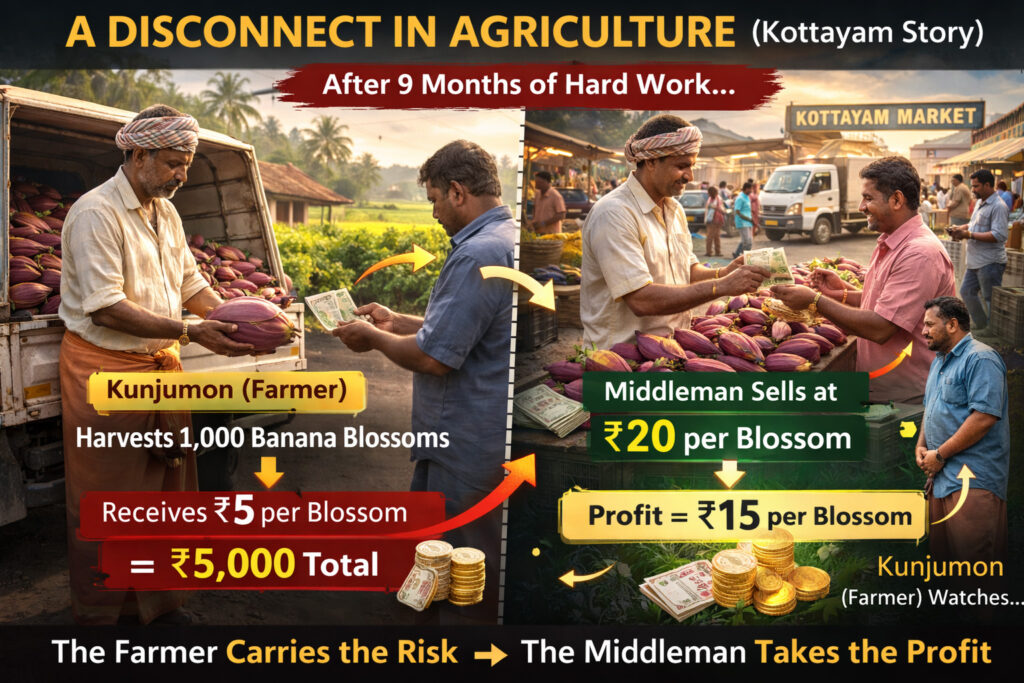
His first concern was simple and stark: agriculture is not profitable.
The cost of labor in Kerala is among the highest in India. Landholdings are fragmented and small. Mechanization is difficult in many terrains. For many crops, the cost of production exceeds what markets are willing to pay. Farmers struggle not because they lack knowledge, but because the economics are unforgiving.
His second concern was social: young people do not see agriculture as an aspirational career.
In a state where parents proudly raise doctors, engineers, and global professionals, farming has slowly slipped down the prestige ladder. Agriculture is seen as labor-intensive, uncertain, and lacking glamour. When profitability declines, dignity follows. When dignity declines, the next generation turns away.
His third concern was deeper and more unsettling: Kerala is gradually losing its agricultural workforce and confidence and at the same time an overuse of chemical poison.
As migration increased, remittances strengthened purchasing power. Families built homes. Land was divided. Some paddy fields gave way to housing plots. Others shifted to perennial cash crops. Food could be bought from elsewhere. The market seemed efficient. Specialization appeared rational.
In economic theory, this is not irrational. Regions specialize in what they do best. Kerala exports services and skilled manpower; it imports food. Trade balances the equation.
But food is not just another commodity.
Food is security.
Food is sovereignty.
Food is cultural continuity.
When a society distances itself from food production, it becomes vulnerable — to supply chain disruptions, to price shocks, to climate failures in distant regions. More subtly, it risks losing generational knowledge of soil, seasons, and sustainability.
The paradox of Kerala is not that it failed. It is that it succeeded — in education, in health, in human development — but did not simultaneously modernize agriculture to match its intellectual capital.
Agriculture in Kerala cannot return to the past. Nor should it romanticize hardship. The solution is not to compel young people back to fields of uncertainty. The solution is to redesign agriculture itself.
If Kerala can produce world-class doctors and engineers, it can produce world-class Agri-entrepreneurs. If it can build hospitals and IT parks, it can build precision farming clusters, farmer-producer organizations, high-value horticulture systems, and technology-enabled supply chains.
The future of food production in Kerala lies in:
- Making agriculture economically viable through aggregation and scale.
- Leveraging technology — precision farming, protected cultivation, AI-driven advisories.
- Promoting high-value, climate-resilient crops.
- Reframing farming as enterprise, not subsistence.
- Restoring dignity to those who work the soil.
Kerala’s literacy is not merely the ability to read and write. It is the capacity to adapt. The state has repeatedly reinvented itself — socially, politically, economically. Agriculture must be part of that reinvention.
We must ask a simple question: in a state celebrated for human development, can food security be outsourced indefinitely?
The answer need not be alarmist. Kerala will always trade. It will always interact with neighboring states. Interdependence is natural. But resilience requires a base — a minimum level of self-reliant production, especially in essentials.
The story of Kerala is ultimately a story of people. A people who valued education. Who crossed oceans for opportunity. Who built a global footprint while remaining rooted in a small strip of land between mountains and sea.
The next chapter may not be about choosing between globalization and agriculture.
It may be about bringing the same intelligence, dignity, and innovation that built Kerala’s human capital — back to its soil.
Because a society that invests in minds must not neglect the ground that feeds them.