Citrus Espaliers: History, Technique, and Application in Citrus Cultivation
Production Date: August 18, 2025
Introduction: What is an Espalier?
Espalier, pronounced es-pal-YAY, is the ancient horticultural practice of training fruit trees to grow flat against a structure, such as a wall, trellis, or series of wires. The technique originated with 16th–17th century European master gardeners who sought to grow fruit in confined courtyards, castle gardens, and monasteries. By flattening the branching habit into a two-dimensional framework, they maximized space, encouraged early ripening, and created beautiful living architecture. Today, espalier remains both a practical and artistic method, particularly cherished by citrus enthusiasts who appreciate the combination of edible harvests and landscape beauty.
Espalier Beyond Citrus
Although citrus is a wonderful candidate for espalier, the technique has long been used with other fruit crops. Apples and pears are perhaps the most iconic espaliered trees, especially in Europe, where their naturally pliable growth habit made them ideal. Figs, stone fruits, and even ornamentals have also been espaliered successfully. The allure of espalier lies not only in saving space but in blending horticulture with artistry, turning functional fruit production into a living sculpture.
Citrus Varieties Suited to Espalier
While nearly any dwarf or standard citrus can be espaliered, some varieties are particularly well suited due to their flexible, vining growth habit or compact nature. Among the best choices are:
– Eureka and Ponderosa lemons
– Nagami kumquat
– Eustis limequat
– Tarocco blood orange
– Chandler pummelo
These selections combine vigorous growth with excellent fruiting on horizontal wood. For best results, espalier training should begin with a young tree rather than attempting to retrain a mature specimen, which is far more difficult to shape.
Espalier Patterns and Training Systems
Espaliers can take on many geometric or naturalized patterns, each suited to the gardener’s taste and the tree’s growth habit:
– **Horizontal Cordon**: Classic and simple, this pattern involves training single branches horizontally along a series of wires. Layers can be repeated at different heights.
– **Candelabra**: Multiple upright arms grow from a central trunk, resembling a chandelier.
– **Double U-Shape**: Two sets of bends form symmetrical arches on either side.
– **Palmette**: Fan-shaped design, spreading branches like an open hand.
– **Random Form**: A more casual, less structured arrangement, still confined to a flat plane.
Each pattern requires regular pruning and thoughtful branch selection to achieve balance and productivity.
Wires, Supports, and Spacing
Strong, durable support is essential for citrus espalier. Galvanized 12- to 14-gauge wire is recommended for horizontal cordons, fastened securely with eyescrews or bolts set into wood or masonry. Wooden trellises provide an alternative and can add architectural appeal. Plastic-coated wires may be used but tend to degrade over time compared to metal. For freestanding espaliers, posts anchored in the ground with horizontal wires stretched between them are effective. Always keep the tree 8–12 inches away from walls or fences to allow adequate air circulation, which is critical for disease prevention.
Steps for Training Citrus Espaliers
1. **Initial Training**: Cut the trunk at the desired height for the first cordon. Select the strongest shoots and guide them along the horizontal wires, removing unwanted growth.
2. **Branch Development**: Allow branches to extend horizontally. As they mature, tips may droop under the weight of fruit, which encourages additional upward side shoots that can be trained further.
3. **Additional Cordons**: Once the first tier is established, repeat the process above at higher levels on the trunk. Pinch new shoots back at the second wire to force side branching.
4. **Maintenance**: Regularly prune away wayward or excessive growth to maintain the form. Espaliers require vigilance but reward patience with structure and productivity.
Key Terms and Concepts
– **Cordon**: A trained horizontal branch extending from the trunk.
– **Palmette**: A fan-shaped espalier form with radiating arms.
– **Candelabra**: Multiple vertical arms branching upward from a central trunk, resembling candlesticks.
Why Citrus Enthusiasts Love Espaliers
Espaliered citrus trees offer both practical and aesthetic rewards. For gardeners with limited space, they allow fruit trees to thrive in narrow beds, patios, or urban courtyards. Against a warm south-facing wall, espaliers often ripen fruit earlier and can help protect sensitive varieties from cold injury. Beyond function, they add elegance and order to landscapes, transforming ordinary fruit trees into living art forms.
Challenges and Considerations
While espalier is rewarding, it requires commitment. Gardeners must be willing to prune and tie branches several times a year. Results are not immediate—achieving a refined espalier form may take three to five years. Larger citrus varieties, such as pummelos or ponderosa lemons, demand sturdier support structures. Cold climates also pose challenges, though training against a heat-retaining wall can mitigate frost damage. Ultimately, espalier is an investment in patience, precision, and creativity.
University Extension References
– University of California Agriculture & Natural Resources (ANR): *Training and Pruning Citrus Trees*
– Texas A&M AgriLife Extension: *Citrus for Southern Landscapes*
– University of Florida IFAS Extension: *Citrus Homeowner’s Guide*
– Washington State University Extension: *Espalier Training Systems*
Conclusion
Espalier is both an art and a science. In citrus, it merges practicality—efficient fruit production—with ornamental beauty. Whether shaping a lemon tree into a horizontal cordon, training a kumquat into a fan-shaped palmette, or experimenting with candelabra forms, espalier transforms citrus cultivation into a creative journey. For those willing to invest time and care, espaliers offer a harvest of both fruit and artistry, enriching gardens and landscapes for years to come.
Citrus Espaliers: History, Technique, and Application in Citrus Cultivation
Author: Dr. Mani Skaria, Ph.D.
Introduction: What is an Espalier?
Espalier, pronounced es-pal-YAY, is the ancient horticultural practice of training fruit trees to grow flat against a structure, such as a wall, trellis, or series of wires. The technique originated with 16th–17th century European master gardeners who sought to grow fruit in confined courtyards, castle gardens, and monasteries. By flattening the branching habit into a two-dimensional framework, they maximized space, encouraged early ripening, and created beautiful living architecture. Today, espalier remains both a practical and artistic method, particularly cherished by citrus enthusiasts who appreciate the combination of edible harvests and landscape beauty.
Espalier Beyond Citrus
Although citrus is a wonderful candidate for espalier, the technique has long been used with other fruit crops. Apples and pears are perhaps the most iconic espaliered trees, especially in Europe, where their naturally pliable growth habit made them ideal. Figs, stone fruits, and even ornamentals have also been espaliered successfully. The allure of espalier lies not only in saving space but in blending horticulture with artistry, turning functional fruit production into a living sculpture.
Citrus Varieties Suited to Espalier
While nearly any dwarf or standard citrus can be espaliered, some varieties are particularly well-suited due to their flexible, vining growth habit or compact nature. Among the best choices are:
– Eureka and Ponderosa lemons
– Nagami kumquat
– Eustis limequat
– Tarocco blood orange
– Chandler pummelo
These selections combine vigorous growth with excellent fruiting on horizontal wood. For best results, espalier training should begin with a young tree rather than attempting to retrain a mature specimen, which is far more difficult to shape.
 Espalier Patterns and Training Systems
Espaliers can take on many geometric or naturalized patterns, each suited to the gardener’s taste and the tree’s growth habit:
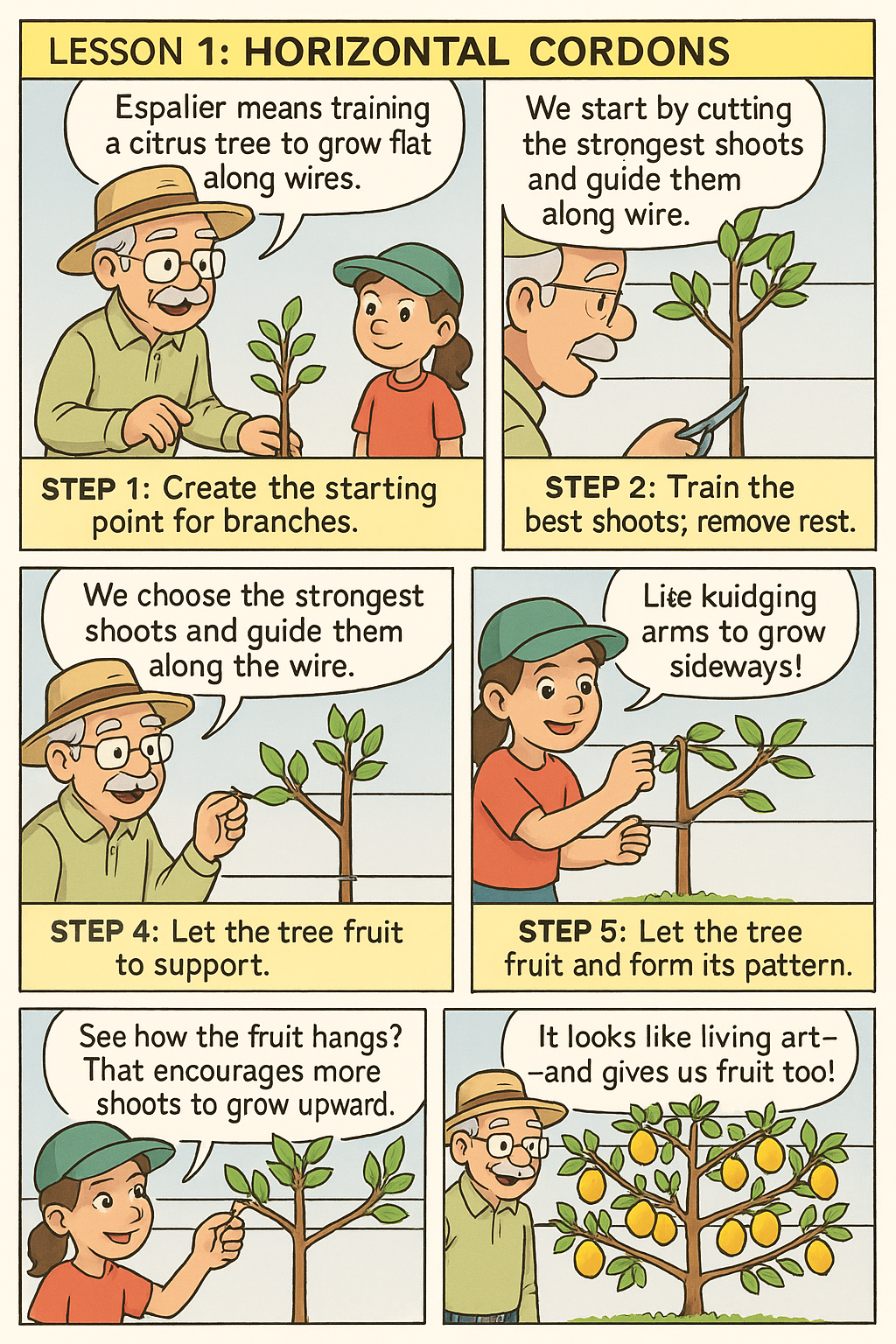
– **Horizontal Cordon**: Classic and simple, this pattern involves training single branches horizontally along a series of wires. Layers can be repeated at different heights.
– **Candelabra**: Multiple upright arms grow from a central trunk, resembling a chandelier.
– **Double U-Shape**: Two sets of bends form symmetrical arches on either side.
– **Palmette**: Fan-shaped design, spreading branches like an open hand.
– **Random Form**: A more casual, less structured arrangement, still confined to a flat plane.
Each pattern requires regular pruning and thoughtful branch selection to achieve balance and productivity.
Wires, Supports, and Spacing
Strong, durable support is essential for citrus espalier. Galvanized 12- to 14-gauge wire is recommended for horizontal cordons, fastened securely with eyescrews or bolts set into wood or masonry. Wooden trellises provide an alternative and can add architectural appeal. Plastic-coated wires may be used but tend to degrade over time compared to metal. For freestanding espaliers, posts anchored in the ground with horizontal wires stretched between them are effective. Always keep the tree 8–12 inches away from walls or fences to allow adequate air circulation, which is critical for disease prevention.
Steps for Training Citrus Espaliers
1. **Initial Training**: Cut the trunk at the desired height for the first cordon. Select the strongest shoots and guide them along the horizontal wires, removing unwanted growth.
2. **Branch Development**: Allow branches to extend horizontally. As they mature, tips may droop under the weight of fruit, which encourages additional upward side shoots that can be trained further.
3. **Additional Cordons**: Once the first tier is established, repeat the process above at higher levels on the trunk. Pinch new shoots back at the second wire to force side branching.
4. **Maintenance**: Regularly prune away wayward or excessive growth to maintain the form. Espaliers require vigilance but reward patience with structure and productivity.
Key Terms and Concepts
– **Cordon**: A trained horizontal branch extending from the trunk.
– **Palmette**: A fan-shaped espalier form with radiating arms.
– **Candelabra**: Multiple vertical arms branching upward from a central trunk, resembling candlesticks.
Why Citrus Enthusiasts Love Espaliers
Espaliered citrus trees offer both practical and aesthetic rewards. For gardeners with limited space, they allow fruit trees to thrive in narrow beds, patios, or urban courtyards. Against a warm south-facing wall, espaliers often ripen fruit earlier and can help protect sensitive varieties from cold injury. Beyond function, they add elegance and order to landscapes, transforming ordinary fruit trees into living art forms.
Challenges and Considerations
While espalier is rewarding, it requires commitment. Gardeners must be willing to prune and tie branches several times a year. Results are not immediate—achieving a refined espalier form may take three to five years. Larger citrus varieties, such as pummelos or ponderosa lemons, demand sturdier support structures. Cold climates also pose challenges, though training against a heat-retaining wall can mitigate frost damage. Ultimately, espalier is an investment in patience, precision, and creativity.
University Extension References
– University of California Agriculture & Natural Resources (ANR): *Training and Pruning Citrus Trees*
– Texas A&M AgriLife Extension: *Citrus for Southern Landscapes*
– University of Florida IFAS Extension: *Citrus Homeowner’s Guide*
– Washington State University Extension: *Espalier Training Systems*
Conclusion
Espalier is both an art and a science. In citrus, it merges practicality—efficient fruit production—with ornamental beauty. Whether shaping a lemon tree into a horizontal cordon, training a kumquat into a fan-shaped palmette, or experimenting with candelabra forms, espalier transforms citrus cultivation into a creative journey. For those willing to invest time and care, espaliers offer a harvest of both fruit and artistry, enriching gardens and landscapes for years to come.
History of the Word ‘Cordon’
The term ‘cordon’ originates from the French word meaning ‘cord’ or ‘string.’ In the 16th and 17th centuries, European gardeners tied fruit tree branches to cords or wires stretched against walls to guide their growth. Over time, the word ‘cordon’ came to describe a deliberately trained branch or stem, often horizontal, vertical, or angled, as part of a formal espalier design. This distinguished it from a simple ‘horizontal branch,’ which might grow sideways naturally without intentional training. Using ‘cordon’ emphasizes both the geometric design and horticultural discipline of espalier systems, making it an internationally recognized technical term in gardening literature. Thus, a ‘horizontal cordon’ is not just a branch growing sideways, but a branch deliberately shaped, guided, and maintained as part of the espalier framework.
Espalier Glossary
A quick reference to key espalier forms, with illustration.
–Cordon: A trained branch growing horizontally, vertically, or obliquely along
a wire or any support.
– Palmette: A fan-shaped espalier with branches radiating outward.
– Candelabra: A form with multiple upright arms, resembling candlesticks.
– Double U-Shape: Two sets of upward bends forming symmetrical arches.
Quotes on Espalier and Gardening
“A garden requires patient labor and attention. Plants do not grow merely to satisfy ambitions or to fulfill good intentions. They thrive because someone expended effort on them.”
– Liberty Hyde Bailey (Father of American Horticulture)
“Training a citrus tree into espalier is more than gardening—it is a living art, where patience shapes both the tree and the grower.”
Mani Skaria, PhD.
-END-
Citrus Espaliers: History, Technique, and Application in Citrus Cultivation
Author: Dr. Mani Skaria, Ph.D.
Introduction: What is an Espalier?
Espalier, pronounced es-pal-YAY, is the ancient horticultural practice of training fruit trees to grow flat against a structure, such as a wall, trellis, or series of wires. The technique originated with 16th–17th century European master gardeners who sought to grow fruit in confined courtyards, castle gardens, and monasteries. By flattening the branching habit into a two-dimensional framework, they maximized space, encouraged early ripening, and created beautiful living architecture. Today, espalier remains both a practical and artistic method, particularly cherished by citrus enthusiasts who appreciate the combination of edible harvests and landscape beauty.
Espalier Beyond Citrus
Although citrus is a wonderful candidate for espalier, the technique has long been used with other fruit crops. Apples and pears are perhaps the most iconic espaliered trees, especially in Europe, where their naturally pliable growth habit made them ideal. Figs, stone fruits, and even ornamentals have also been espaliered successfully. The allure of espalier lies not only in saving space but in blending horticulture with artistry, turning functional fruit production into a living sculpture.
Citrus Varieties Suited to Espalier
While nearly any dwarf or standard citrus can be espaliered, some varieties are particularly well-suited due to their flexible, vining growth habit or compact nature. Among the best choices are:
– Eureka and Ponderosa lemons
– Nagami kumquat
– Eustis limequat
– Tarocco blood orange
– Chandler pummelo
These selections combine vigorous growth with excellent fruiting on horizontal wood. For best results, espalier training should begin with a young tree rather than attempting to retrain a mature specimen, which is far more difficult to shape.
 Espalier Patterns and Training Systems
Espaliers can take on many geometric or naturalized patterns, each suited to the gardener’s taste and the tree’s growth habit:
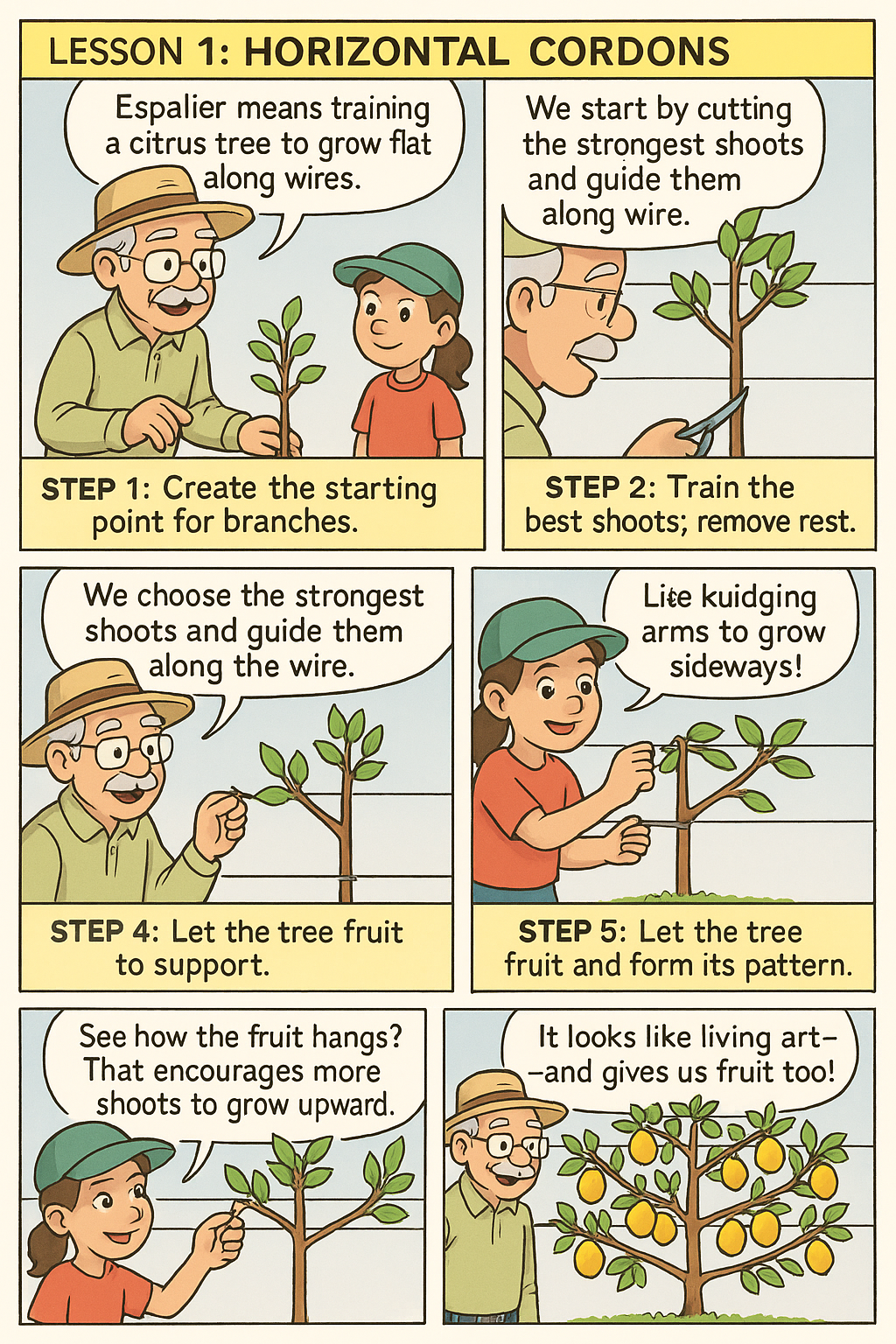
– **Horizontal Cordon**: Classic and simple, this pattern involves training single branches horizontally along a series of wires. Layers can be repeated at different heights.
– **Candelabra**: Multiple upright arms grow from a central trunk, resembling a chandelier.
– **Double U-Shape**: Two sets of bends form symmetrical arches on either side.
– **Palmette**: Fan-shaped design, spreading branches like an open hand.
– **Random Form**: A more casual, less structured arrangement, still confined to a flat plane.
Each pattern requires regular pruning and thoughtful branch selection to achieve balance and productivity.
Wires, Supports, and Spacing
Strong, durable support is essential for citrus espalier. Galvanized 12- to 14-gauge wire is recommended for horizontal cordons, fastened securely with eyescrews or bolts set into wood or masonry. Wooden trellises provide an alternative and can add architectural appeal. Plastic-coated wires may be used but tend to degrade over time compared to metal. For freestanding espaliers, posts anchored in the ground with horizontal wires stretched between them are effective. Always keep the tree 8–12 inches away from walls or fences to allow adequate air circulation, which is critical for disease prevention.
Steps for Training Citrus Espaliers
1. **Initial Training**: Cut the trunk at the desired height for the first cordon. Select the strongest shoots and guide them along the horizontal wires, removing unwanted growth.
2. **Branch Development**: Allow branches to extend horizontally. As they mature, tips may droop under the weight of fruit, which encourages additional upward side shoots that can be trained further.
3. **Additional Cordons**: Once the first tier is established, repeat the process above at higher levels on the trunk. Pinch new shoots back at the second wire to force side branching.
4. **Maintenance**: Regularly prune away wayward or excessive growth to maintain the form. Espaliers require vigilance but reward patience with structure and productivity.
Key Terms and Concepts
– **Cordon**: A trained horizontal branch extending from the trunk.
– **Palmette**: A fan-shaped espalier form with radiating arms.
– **Candelabra**: Multiple vertical arms branching upward from a central trunk, resembling candlesticks.
Why Citrus Enthusiasts Love Espaliers
Espaliered citrus trees offer both practical and aesthetic rewards. For gardeners with limited space, they allow fruit trees to thrive in narrow beds, patios, or urban courtyards. Against a warm south-facing wall, espaliers often ripen fruit earlier and can help protect sensitive varieties from cold injury. Beyond function, they add elegance and order to landscapes, transforming ordinary fruit trees into living art forms.
Challenges and Considerations
While espalier is rewarding, it requires commitment. Gardeners must be willing to prune and tie branches several times a year. Results are not immediate—achieving a refined espalier form may take three to five years. Larger citrus varieties, such as pummelos or ponderosa lemons, demand sturdier support structures. Cold climates also pose challenges, though training against a heat-retaining wall can mitigate frost damage. Ultimately, espalier is an investment in patience, precision, and creativity.
University Extension References
– University of California Agriculture & Natural Resources (ANR): *Training and Pruning Citrus Trees*
– Texas A&M AgriLife Extension: *Citrus for Southern Landscapes*
– University of Florida IFAS Extension: *Citrus Homeowner’s Guide*
– Washington State University Extension: *Espalier Training Systems*
Conclusion
Espalier is both an art and a science. In citrus, it merges practicality—efficient fruit production—with ornamental beauty. Whether shaping a lemon tree into a horizontal cordon, training a kumquat into a fan-shaped palmette, or experimenting with candelabra forms, espalier transforms citrus cultivation into a creative journey. For those willing to invest time and care, espaliers offer a harvest of both fruit and artistry, enriching gardens and landscapes for years to come.
History of the Word ‘Cordon’
The term ‘cordon’ originates from the French word meaning ‘cord’ or ‘string.’ In the 16th and 17th centuries, European gardeners tied fruit tree branches to cords or wires stretched against walls to guide their growth. Over time, the word ‘cordon’ came to describe a deliberately trained branch or stem, often horizontal, vertical, or angled, as part of a formal espalier design. This distinguished it from a simple ‘horizontal branch,’ which might grow sideways naturally without intentional training. Using ‘cordon’ emphasizes both the geometric design and horticultural discipline of espalier systems, making it an internationally recognized technical term in gardening literature. Thus, a ‘horizontal cordon’ is not just a branch growing sideways, but a branch deliberately shaped, guided, and maintained as part of the espalier framework.
Espalier Glossary
A quick reference to key espalier forms, with illustration.
–Cordon: A trained branch growing horizontally, vertically, or obliquely along
a wire or any support.
– Palmette: A fan-shaped espalier with branches radiating outward.
– Candelabra: A form with multiple upright arms, resembling candlesticks.
– Double U-Shape: Two sets of upward bends forming symmetrical arches.
Quotes on Espalier and Gardening
“A garden requires patient labor and attention. Plants do not grow merely to satisfy ambitions or to fulfill good intentions. They thrive because someone expended effort on them.”
– Liberty Hyde Bailey (Father of American Horticulture)
“Training a citrus tree into espalier is more than gardening—it is a living art, where patience shapes both the tree and the grower.”
Mani Skaria, PhD.
-END-
Citrus Espaliers: History, Technique, and Application in Citrus Cultivation
Author: Dr. Mani Skaria, Ph.D.
Introduction: What is an Espalier?
Espalier, pronounced es-pal-YAY, is the ancient horticultural practice of training fruit trees to grow flat against a structure, such as a wall, trellis, or series of wires. The technique originated with 16th–17th century European master gardeners who sought to grow fruit in confined courtyards, castle gardens, and monasteries. By flattening the branching habit into a two-dimensional framework, they maximized space, encouraged early ripening, and created beautiful living architecture. Today, espalier remains both a practical and artistic method, particularly cherished by citrus enthusiasts who appreciate the combination of edible harvests and landscape beauty.
Espalier Beyond Citrus
Although citrus is a wonderful candidate for espalier, the technique has long been used with other fruit crops. Apples and pears are perhaps the most iconic espaliered trees, especially in Europe, where their naturally pliable growth habit made them ideal. Figs, stone fruits, and even ornamentals have also been espaliered successfully. The allure of espalier lies not only in saving space but in blending horticulture with artistry, turning functional fruit production into a living sculpture.
Citrus Varieties Suited to Espalier
While nearly any dwarf or standard citrus can be espaliered, some varieties are particularly well-suited due to their flexible, vining growth habit or compact nature. Among the best choices are:
– Eureka and Ponderosa lemons
– Nagami kumquat
– Eustis limequat
– Tarocco blood orange
– Chandler pummelo
These selections combine vigorous growth with excellent fruiting on horizontal wood. For best results, espalier training should begin with a young tree rather than attempting to retrain a mature specimen, which is far more difficult to shape.
 Espalier Patterns and Training Systems
Espaliers can take on many geometric or naturalized patterns, each suited to the gardener’s taste and the tree’s growth habit:
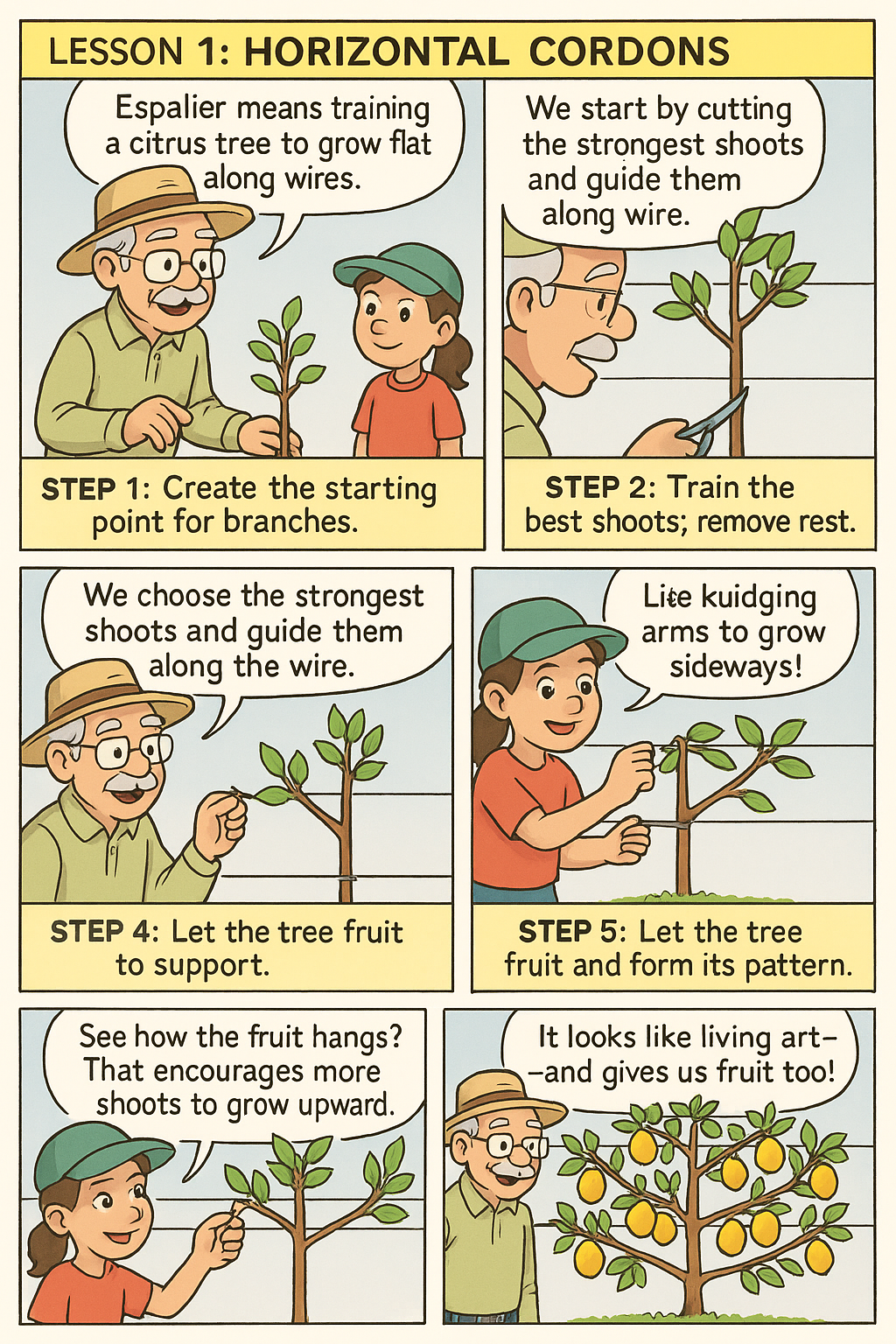
– **Horizontal Cordon**: Classic and simple, this pattern involves training single branches horizontally along a series of wires. Layers can be repeated at different heights.
– **Candelabra**: Multiple upright arms grow from a central trunk, resembling a chandelier.
– **Double U-Shape**: Two sets of bends form symmetrical arches on either side.
– **Palmette**: Fan-shaped design, spreading branches like an open hand.
– **Random Form**: A more casual, less structured arrangement, still confined to a flat plane.
Each pattern requires regular pruning and thoughtful branch selection to achieve balance and productivity.
Wires, Supports, and Spacing
Strong, durable support is essential for citrus espalier. Galvanized 12- to 14-gauge wire is recommended for horizontal cordons, fastened securely with eyescrews or bolts set into wood or masonry. Wooden trellises provide an alternative and can add architectural appeal. Plastic-coated wires may be used but tend to degrade over time compared to metal. For freestanding espaliers, posts anchored in the ground with horizontal wires stretched between them are effective. Always keep the tree 8–12 inches away from walls or fences to allow adequate air circulation, which is critical for disease prevention.
Steps for Training Citrus Espaliers
1. **Initial Training**: Cut the trunk at the desired height for the first cordon. Select the strongest shoots and guide them along the horizontal wires, removing unwanted growth.
2. **Branch Development**: Allow branches to extend horizontally. As they mature, tips may droop under the weight of fruit, which encourages additional upward side shoots that can be trained further.
3. **Additional Cordons**: Once the first tier is established, repeat the process above at higher levels on the trunk. Pinch new shoots back at the second wire to force side branching.
4. **Maintenance**: Regularly prune away wayward or excessive growth to maintain the form. Espaliers require vigilance but reward patience with structure and productivity.
Key Terms and Concepts
– **Cordon**: A trained horizontal branch extending from the trunk.
– **Palmette**: A fan-shaped espalier form with radiating arms.
– **Candelabra**: Multiple vertical arms branching upward from a central trunk, resembling candlesticks.
Why Citrus Enthusiasts Love Espaliers
Espaliered citrus trees offer both practical and aesthetic rewards. For gardeners with limited space, they allow fruit trees to thrive in narrow beds, patios, or urban courtyards. Against a warm south-facing wall, espaliers often ripen fruit earlier and can help protect sensitive varieties from cold injury. Beyond function, they add elegance and order to landscapes, transforming ordinary fruit trees into living art forms.
Challenges and Considerations
While espalier is rewarding, it requires commitment. Gardeners must be willing to prune and tie branches several times a year. Results are not immediate—achieving a refined espalier form may take three to five years. Larger citrus varieties, such as pummelos or ponderosa lemons, demand sturdier support structures. Cold climates also pose challenges, though training against a heat-retaining wall can mitigate frost damage. Ultimately, espalier is an investment in patience, precision, and creativity.
University Extension References
– University of California Agriculture & Natural Resources (ANR): *Training and Pruning Citrus Trees*
– Texas A&M AgriLife Extension: *Citrus for Southern Landscapes*
– University of Florida IFAS Extension: *Citrus Homeowner’s Guide*
– Washington State University Extension: *Espalier Training Systems*
Conclusion
Espalier is both an art and a science. In citrus, it merges practicality—efficient fruit production—with ornamental beauty. Whether shaping a lemon tree into a horizontal cordon, training a kumquat into a fan-shaped palmette, or experimenting with candelabra forms, espalier transforms citrus cultivation into a creative journey. For those willing to invest time and care, espaliers offer a harvest of both fruit and artistry, enriching gardens and landscapes for years to come.
History of the Word ‘Cordon’
The term ‘cordon’ originates from the French word meaning ‘cord’ or ‘string.’ In the 16th and 17th centuries, European gardeners tied fruit tree branches to cords or wires stretched against walls to guide their growth. Over time, the word ‘cordon’ came to describe a deliberately trained branch or stem, often horizontal, vertical, or angled, as part of a formal espalier design. This distinguished it from a simple ‘horizontal branch,’ which might grow sideways naturally without intentional training. Using ‘cordon’ emphasizes both the geometric design and horticultural discipline of espalier systems, making it an internationally recognized technical term in gardening literature. Thus, a ‘horizontal cordon’ is not just a branch growing sideways, but a branch deliberately shaped, guided, and maintained as part of the espalier framework.
Espalier Glossary
A quick reference to key espalier forms, with illustration.
–Cordon: A trained branch growing horizontally, vertically, or obliquely along
a wire or any support.
– Palmette: A fan-shaped espalier with branches radiating outward.
– Candelabra: A form with multiple upright arms, resembling candlesticks.
– Double U-Shape: Two sets of upward bends forming symmetrical arches.
Quotes on Espalier and Gardening
“A garden requires patient labor and attention. Plants do not grow merely to satisfy ambitions or to fulfill good intentions. They thrive because someone expended effort on them.”
– Liberty Hyde Bailey (Father of American Horticulture)
“Training a citrus tree into espalier is more than gardening—it is a living art, where patience shapes both the tree and the grower.”
Mani Skaria, PhD.
-END-